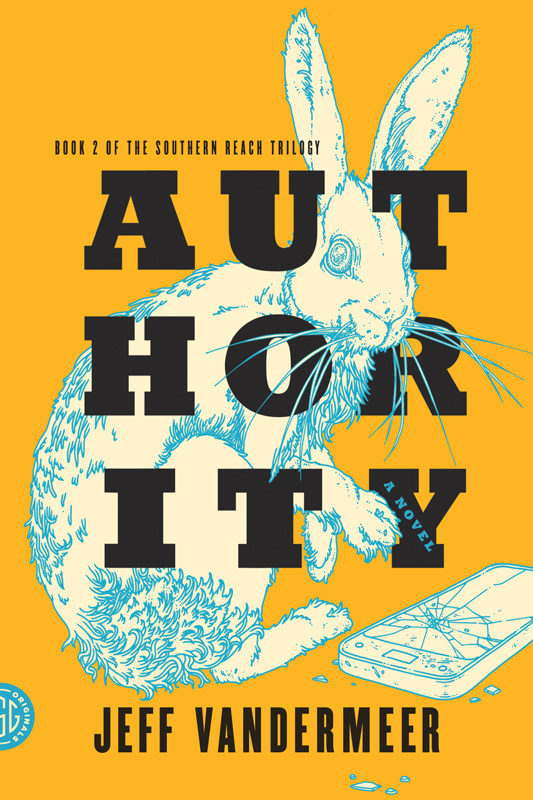
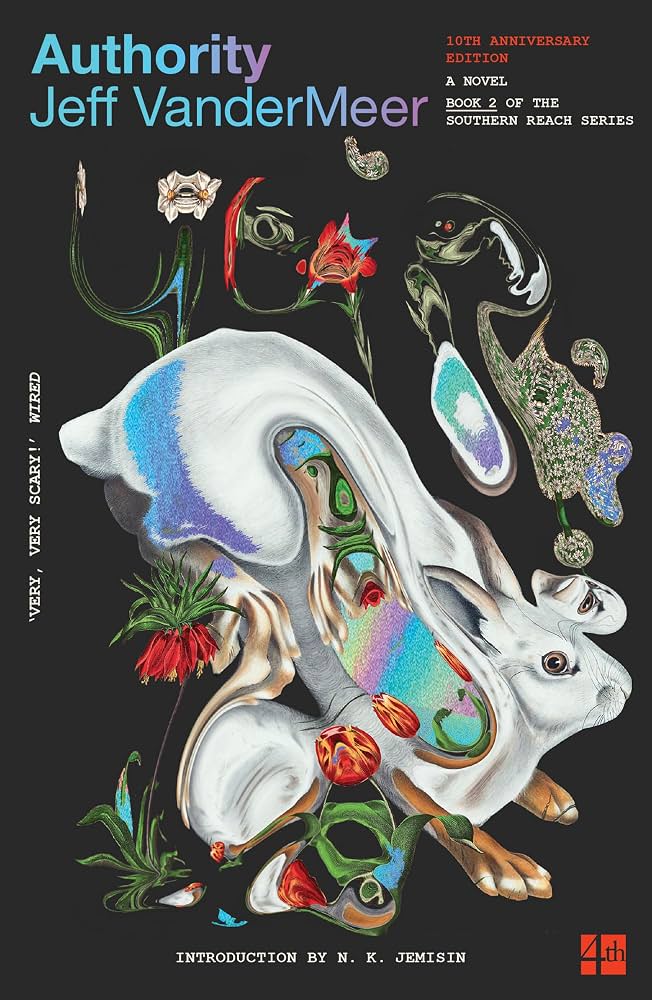
After thirty years, the only human engagement with Area X—a seemingly malevolent landscape surrounded by an invisible border and mysteriously wiped clean of all signs of civilization—has been a series of expeditions overseen by a government agency so secret it has almost been forgotten: the Southern Reach. Following the tumultuous twelfth expedition chronicled in Annihilation, the agency is in complete disarray.
The border extended about seventy miles inland from the lighthouse and approximately forty miles east and forty miles west along the coast. It ended just below the stratosphere and, underground, just above the asthenosphere.
John Rodrigues (aka “Control”) is the Southern Reach’s newly appointed head. Working with a distrustful but desperate team, a series of frustrating interrogations, a cache of hidden notes, and hours of profoundly troubling video footage, Control begins to penetrate the secrets of Area X. But with each discovery he must confront disturbing truths about himself and the agency he’s pledged to serve.
In Authority, the second volume of Jeff VanderMeer’s Southern Reach trilogy, Area X’s most disturbing questions are answered . . . but the answers are far from reassuring.
Praise for ANNIHILATION: ‘A teeming science fiction that draws on Conrad and Lovecraft alike … The writing itself has a clarity that makes the abundance of the setting more powerful. “Annihilation” shows signs of being the novel that will allow VanderMeer to break through to a new and larger audience’ Sunday Telegraph ‘A lasting monument to the uncanny … you find yourself afraid to turn the page … We are less than 200 pages in to the Southern Reach Trilogy … and already home is a distant memory, and an unreliable one, too: for who’s to say that home was not always X at heart?’ Simon Ings, Guardian “Annihilation’ owes much to the explorations of psycho geographical landscapes in early JG Ballard and also to the work of the old masters of weird fiction such as HP Lovecraft and William Hope Hodgson, with their love of nameless horrors haunting liminal realms. VanderMeer synthesizes these influences to create a tale with a deliciously creepy atmosphere of dread’ Financial Times ‘”Annihilation” is a weird and wonderful novel. And the hardback edition is as beautiful as the prose between the covers.’ Metro ‘A tautly told, self-contained story, informed and illuminated by the flawed and very human voice of its narrator’ Arc ‘Immersive, insightful and often deeply bloody creepy, this is a startlingly good novel. If the sequels live up to it, then the Southern Reach series will be a major work’
SFX Magazine ‘A tense and chilling psychological thriller about an unraveling expedition and the strangeness within us. A little Kubrick, a lot of Lovecraft, the novel builds with an unbearable tension and claustrophobic dread that lingers long afterwards. I loved it’ Lauren Beukes ‘Original and beautiful, maddening and magnificent’ Warren Ellis
About the Author
Jeff VanderMeer is an award-winning novelist and editor. He has twice won the World Fantasy Award and has been a finalist for the Hugo Award, Philip K. Dick Award, International Horror Guild Award, British Fantasy Award, Bram Stoker Award, Theodore Sturgeon Memorial Award, and the World Fantasy Award. His fiction has appeared in the Library of America’s American Fantastic Tales and in multiple anthologies.
Original Review: Authority
I realized that I have read this book waaay back in the past when I was writing this article but for the life of me, I couldn’t remember it. Which is a shame as this book was a total disappointment on the second re-read.
So, the book is written from the POV of “Control” and as the book unfolds, all I could think about is that he’s not a reliable narrator. He’s slowly devolving due to the influence of the Southern Reach and the proximity of the border.
“Control” is a fixer. By his own words, he seemed better at identifying other people’s specific problems than at managing his own general ones.
At thirty-eight, that was what he had become known for, if he was known for anything.
It meant you didn’t have to be there for the duration, even though by now that’s exactly what he wanted: to see something through. Problem was, no one really liked a fixer—“Hey,let me show you what you’re doing wrong”—especially if they thought the fixer needed fixing from way back.
As he is dispatched to Southern Reach from “Central”, he is faced with politics, reticent employees and his lack of any trustworthy resources and a mystery that needs to be solved. What happened to the previous director? What is Area X?
“Grace, why are none of you comfortable using the words alien or extraterrestrial to talk about Area X?” He wasn’t comfortable with them, either. Sometimes, since he’d been briefed on the truth, he’d felt a great, empty chasm opening up inside of him, filled with his own screams and yelps of disbelief.
The internal voice of Control is so jarring. He’s constructing a lot of internal monologue which is absolutely dreary to read through and you never know what he observes has meaning or not. Is he observant or dense?
The light that suffused the lake had a claustrophobic gray quality, separate and distinct from the blue sky above.
This, too, had at one time been new, perhaps back during the Cretaceous period, and the building had probably stood here then in some form, reverse engineered so far into the past that you could still look out the windows and see dragonflies as big as vultures.
The U that hugged them close inspired no great confidence; it felt less a symbol of luck than of the incomplete. Incomplete thoughts. Incomplete conclusions. Incomplete reports. The doors at the ends of the U, through which many passed as a shortcut to the other side, confirmed a failure of the imagination. And all the while, the abysmal swamp did whatever swamps did, as perfect in its way as the Southern Reach was imperfect.
Look at this sentence – it didn’t have to reference the Cretacious, his wording is like Milchick’s from Severance.
“We don’t like to reproduce the words because we still don’t know exactly what triggered the creation of Area X … or why.”
And yet they’d left the words up behind the door that led nowhere. Control was struggling to see the logic there.
“That’s superstition,” Hsyu protested. “That’s complete and utter superstition. You shouldn’t say that.” Control knew her parents were very traditional and came from a culture in which spirits manifested and words had a different significance. Hsyu did not share these beliefs—vehemently did not, practicing a lax sort of Christian faith, which brought with it inexplicable elements and phantasmagoria all its own. But he still agreed with her assessment, even if that antipathy might be leaking into her analysis.
She would have continued with a full-blown excoriation of superstition, except that Grace stopped her.[…] Maybe “superstition” was what snuck into the gaps, the cracks, when you worked in a place with falling morale and depleted resources.
The world is not aware of the Southern Reach and what it means to the rest of the world. They know it’s been an environmental disaster and that the area is cordoned off from flying over it or driving to it. The research center, 30 years after the border went up is still in no way closer to knowing if the border and Area X are generated by the same event or two separate events, and after the failure of the first expedition, they started sending in people with no technology and just journals. Less people came back than went in. They had to use conditioning and hypnosis in order to walk through the gateway into Area X as it messed with the senses. They tried so many things and some of them were just swallowed by Area X, some just failed before it happened. And even the people who made it back and the scientists in Southern Reach would not be what they seemed.
On the plane down to his new assignment, he’d had strange thoughts about the inhabitants of those coastal towns to either side of Area X being somehow mutated under the skin. Whole communities no longer what they once were, even though no one could tell this by looking. These were the kinds of thoughts you had to both keep at bay and fuel, if you could manage that trick. You couldn’t become devoured by them, but you had to heed them.
I kept on reading but had to stop every few pages or so because of Control’s own thoughts and way to process what was around him.
Because our minds process information almost solely through analogy and categorization, we are often defeated when presented with something that fits no category and lies outside of the realm of our analogies.” Control imagined the PowerPoint coming to a close, the series of marbled borders giving way to a white screen with the word Questions? on it.
His reaction when seeing the research lab and seeing what the team was doing it:
He had expected, somehow, a Frankenstein laboratory of two-headed calves in formaldehyde and some hideous manservant with a hunchback lurching ahead of them and explaining it all in an incomprehensible bouillabaisse of good intentions and slurred syntax. But it was just Whitby, and it was just Grace, and in that cathedral neither felt inclined to explain anything.
Sometimes it feels like this entire book was an incomprehensible bouillabaisse of good intentions and slurred syntax.
I’m not even sure when Control started going off the rails? Was it when he started smelling the rotten honey which he assumed was coming from the cleaning product? There was a note in the previous book (Annihilation) that the tower smelled faintly sweet, like mead – and if you know anything about mead it is like fermented honey which turns into alchool. Honey itself doesn’t rot due to the high sugar content. His
According to a labyrinthine hierarchical chart that resembled several thick snakes fucking one another, the Southern Reach was under the army’s jurisdiction here, which might be why the Southern Reach facility, closed down between expeditions, looked a bit like a row of large tents that had been made of lemon meringue. Which is to say, it looked like any number of the churches Control had become familiar with in his teenage years, usually because of whatever girl he was dating. The calcification of revivalists and born-agains often took this form: as of something temporary that had hardened and become permanent. And thus it was either a series of white permafrost tents that greeted them or the white swell of huge waves, frozen forever. The sight was as out of place and startling as if the facility had resembled a fossilized herd of huge MoonPies, a delicacy of those youthful years.
This guy is gone. He is remembering his youth a lot, where he used to go as a teen, who he used to date. His absent secret agent mother, his Mexican artist father with a hand in creating massive sculptures which no-one would buy and ended up in his relative’s gardens and as a miniature chess set. I had to read so much of his past life – his failed agent status, his “demotion” to Southern Reach to “sort it out”. His internal thoughts boring the hell out of me.
Just how elephantine, how rhinoceroscrutian, had the Voice’s efforts been in following up on Control’s request?
Umm, can we not? Some of these words are not even real.
But his head was full of scraps of notes and the puzzle of a possible clandestine trip by the director across the border and the deadly echo of muffled interiors of jewelry boxes.
The comparisons keep going..
A scrawny pine tree half-throttled by rusted Christmas lights stood beside the shed. The water was choked with duckweed and hydrangea and water lilies. Dragonflies patrolled ceaselessly over the gray, sometimes black water. The frogs made such raucous forecasts of rain that they drowned out the crickets and, from the fringe of grass and bushes on the opposite side of the pond, came the chatter and bustle of wrens and warblers.
A lone great blue heron stood solemn and silent in the middle of the pond. Thunderclouds continued to gather, its feathers dull in the fading light.
And then the sentences without a subject or a verb. Have a look at this beaut:
Finally, though, Control could no longer fool himself. The famous twenty-second clip had come up, which the file indicated had been shot by Lowry, who had served as both the team’s anthropologist and its military expert. Dusk of the second day, with a lisp of sunset. Dull dark tower of the lighthouse in the middle distance. In their innocence, they had not seen the harm in splitting up, and Lowry’s group had decided to bivouac on the trail, among the remains of an abandoned series of houses about halfway to the lighthouse. It had hardly been enough to constitute a village, with no name on the maps, but had been the largest population center in the area.
and
While he lies in wait, there, at the bottom of the cliff, swimming vast and unknowable among the other monsters. Waiting in the darkness for the soundless fall, without splash or ripple.
And then we have extra metaphors:
He used guns, but he didn’t like them and didn’t like relying on them. They smelled like their perspective.
What the hell does he mean by “they smelled like their perspective”? They smelled bad? They smelled skewed? They smelled messy? Bloody? Direct? It’s crap like this that got me stopping every few sentences, interrupting the flow of the book to think why did the author choose this specific set of words to say that Control didn’t like relying on guns? Why was the smell part important? Or necessary?
The book continues to climb to new mystery heights, where Whitby the scientist is found paiting a new dome at the top of the supply closet, like a weary Michelangelo. He’s been acting like a beacon for the director, already infected by whatever was inside area X. And the Director does return, making her acolyte, Grace, so happy to see her she refused to move. And the director brought with her the border of Area X, contaminating everything in sight.
When Control runs off, scared, his mother – the super secret agent lady – was waiting at his rental home to tell him some essential information she really should have told him before the mission started. I hate it when something is so top secret that a person cannot even operate correctly as the information he so desperately needs is classified.
Imagine a situation, John, in which you are trying to contain something dangerous. But you suspect that containment is a losing game. That what you want to contain is escaping slowly, inexorably. That what seems impermeable is, in fact, over time becoming very permeable. That the divide is more perforated than unperforated. And that whatever this thing is seems to want to destroy you but has no leader to negotiate with, no stated goals of any kind.” It was almost a speech he could imagine the director giving.
“You mean the Southern Reach, the place you sent me into. With the wrong tools.”“I mean that the group I’ve been part of has believed for a while now that the Southern Reach might be compromised, but the majority have believed, until today, that this wasn’t just wrong but laughably ridiculous.”
His mother and Central didn’t even tell him that the Director had gone into Area X on her own and she’d just been given a slap on her wrist when she returned. It’s only when “Control” found out from rumours and hints that they came clean about that. They also hadn’t shared with “Control” the info from her house – the writing on the wall and what it meant and who the debriefing voice was.
In the end, Control absconds and runs off to where he thinks he will find the person he spent so long interviewing – the biologist. He does find her after at least three chapters of searching and when they meet it’s really awkward – as he is intruding in her space and she never wanted to meet him again (unlike he did). But at least they clear off some items that she repeated multiple times, that “Control” only know understands.
  “I’m not the biologist,” she said. “I don’t care about my past as the biologist, if that’s what you mean.”

  “I know,” he said. He’d figured it out on the boat, even if he hadn’t articulated it yet. “I know you’re not. You’re some version, though. You have her memories, to some extent, and somewhere back in Area X, the biologist may still be alive. You’re a replica, but you’re your own person.”