If his voice had a taste it would be like one of those artisanal chili-pepper dark chocolate bars. If it were a color it would match the eyes that are currently boring into mine.
This book was a very beautifully written love story from a girl to her daddy. A man who was gone before his time but he left her with a lot of love and a legacy of magic in the land they owned.
At the sound of my name, whole forests grow from saplings into moonlit redwoods beneath my collarbones. I can’t wait for this feeling to stop, so I can be on Dad’s side like I always have been.
Romeo and Juliet meets One Hundred Years of Solitude in Emily Henry’s brilliant follow-up to The Love That Split the World, about the daughter and son of two long-feuding families who fall in love while trying to uncover the truth about the strange magic and harrowing curse that has plagued their bloodlines for generations.
In their hometown of Five Fingers, Michigan, the O’Donnells and the Angerts have mythic legacies. But for all the tall tales they weave, both founding families are tight-lipped about what caused the century-old rift between them, except to say it began with a cherry tree.
Eighteen-year-old Jack “June” O’Donnell doesn’t need a better reason than that. She”s an O”Donnell to her core, just like her late father was, and O’Donnells stay away from Angerts. Period.
But when Saul Angert, the son of June”s father”s mortal enemy, returns to town after three mysterious years away, June can”t seem to avoid him. Soon the unthinkable happens: She finds she doesn’t exactly hate the gruff, sarcastic boy she was born to loathe.
Saul’s arrival sparks a chain reaction, and as the magic, ghosts, and coywolves of Five Fingers conspire to reveal the truth about the dark moment that started the feud, June must question everything she knows about her family and the father she adored. And she must decide whether it”s finally time for her—and all of the O’Donnells before her—to let go.
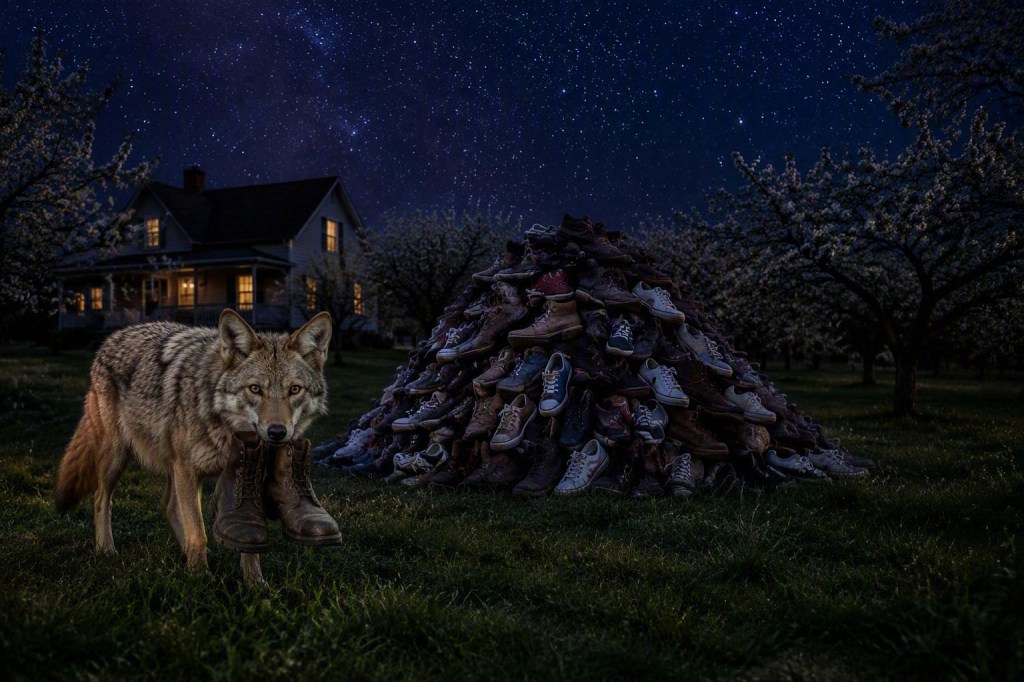
There is a bit of magic in this land. Whenever June opens the door to the backyard, sometimes she steps into another time, another place. I loved the way “the thin places” are used. “Thin places” are indeed an ancient Celtic concept as the book states. Places where we can slip between our world and the Otherworld. In this case, for June and Saul to discover what really happened to the people they lost and about family members lost in past generations. Most important they learn the root of the families hatred and curse. If they so choose, they can let it go…
The biggest difference, aside from the change from night to day, is a four-foot-high pile of shoes in the middle of the yard. As we stand there, a coywolf picks across the grass, Saul’s boots dangling from its jowls. It drops the shoes at the edge of the pile and turns aside, pausing to meet our eyes before trotting off.
The magic doesn’t stop for a moment. The story of June and Saul is not nearly as interesting as the story of June and her dad. Through the thin places, June can meet her dad again, relive certain memories or see ones from her mom and dad together.
When you lose someone, you start to feel like there’s an expiration date on your crying. All your friends and neighbors and teachers expect it for a couple of weeks. They’ll ask you how you are, and as you’re saying Okay, you’ll begin to shake, and they’ll fold their arms around you until it passes, maybe send you to the bathroom or the office. They expect that for maybe a month, any innocuous question might trigger a process in your brain: homework > you used to do homework at the kitchen table > Dad used to lean over you, chewing on chips as the crumbs fell onto your paper > Dad > Dad’s dead.
It’s not like anyone says you should get over it. But they think—and they’re mostly right—that someday you won’t think about it so much. Or maybe you will. But you’ll only remember things you loved and appreciate that you had them, and the hurt will have burned off like morning mist does as the sun rises higher.
The problem with living in the past or seeing the past too often is that it restarts the counter on the grief clock.
Grief is an unfillable hole in your body. It should be weightless, but it’s heavy. Should be cold, but it burns. Should, over time, close up, but instead it deepens. The pain of missing Dad these last ten years pales in comparison to the pain of having seen him again only to have him ripped away once more.
“My life has been so small. And now it’s finally big. Look at her. Look at my world.” She stands from the table and turns away. “It was like he saw your whole life right then. He didn’t miss a moment. He wouldn’t have dared.”
“You know how sometimes you remember something specific from your childhood, and your parents can confirm it happened, but when you picture it, it’s less like a memory and more like you’re watching it happen to someone else, like a video? Memory is mostly about making connections. We have snippets of real information, bits of imagination and emotions, and we combine them to tell ourselves stories. That could explain how you experience the memories. Sure. They could belong to your dad, but maybe you don’t see them through his eyes because he didn’t really either. His brain created a full to-scale replica of the moments you’re visiting.”
The story built so much up on grief and loss and love and June was absolutely obsessed with walking in her dad’s footsteps and never letting him go. When everything came together in the end and the true realities of the depths of the grief and pain in these families came to full light, I don’t know, I was kind of disappointed with how it was all revealed. The messaging was strong, but I almost felt it was too strong and kept drilling into me the need to let go and move on and while it was beautifully written and you felt the strong emotional bond between June and her father in full fruition, I just wasn’t 100% swept away by the whole thing.
I crash through. There isn’t a doorway to go by. Instead the memory crumbles around me. I don’t have the presence of mind to hold my arms up over my head.
I simply sob. I feel my tired legs collapsing and then solid arms around me. “You’re okay,” he says again and again.
“He loved me,” I cry.
“He loves you.”
“I miss him.”
Saul holds me. We lean together on the front porch, and it’s not the front porch of the other place. It’s the true front porch. Of the here, the now. The one with a frosty cherry tree ringed with sweet saplings.
The hill Jonathan Alroy O’Donnell came to. The hill Jack the First stood on. The hill Jack II rode his bike across and where Jack III showed me the stars. Our home. A thin place.
Where life goes on and the stars keep shining and the person who loved me most has moved on but his heart has somehow stayed behind.
“We’re home.”
Saul nods.
I touch the doorknob. It’s unlocked. I start to shake again, but this time with happiness, relief. Because of what I’ve come home to.

 One Book a Week (Julia Reads Books)