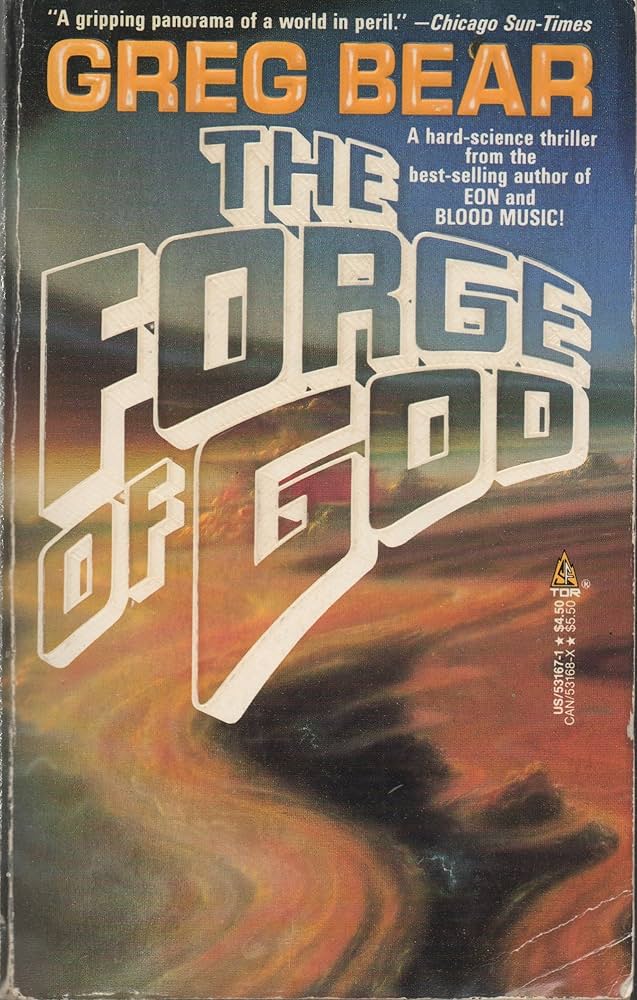
A stunning novel of alien invasion from a master of the genre
Nominee: Hugo Award for Best Science Fiction Novel (1988)
Nominee: Nebula Award for Best Science Fiction Novel (1988)
Nominee: Locus Award for Best Science Fiction Novel (1988)
The disappearance of one of Jupiter’s moons, the appearance of “little green men” in Australia and the American Southwest, and the sudden presence of unidentifiable objects on a collision course inside the Earth’s core add up to the inescapable conclusion that the Earth has been invaded by an enemy it cannot fight.
“God, a superior intelligence, sculpts us all, finds us wanting, and sends our material back into the forge to be reshaped. That thing out there. The Furnace. That’s the forge of God. That’s what we’re up against. Might be up against.”
I’m not completely comfortable with the vastness of the universe.
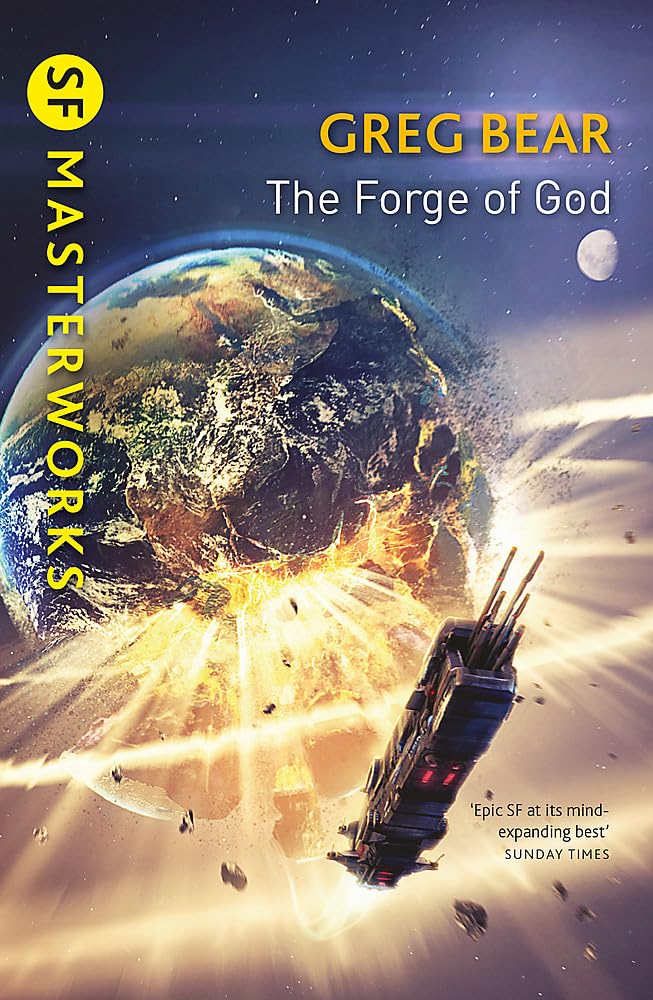
The story starts with the discovery of a dinosaur-shaped alien life in the Mojave desert.
The desert seemed once again innocent of water and change. All around the camp hung a silence more precious than any amount of gold. Not even the wind spoke. […]
“Tell me I’m not seeing what I’m seeing,” he said, pointing to the shade below the rock. Minelli made a face and hurried ahead of Edward.
In the sand, two meters from the boulder, lay something that at first glance resembled a prehistoric flying creature, a pteranodon perhaps, wings folded, canted over to one side.
It was not mineral, Edward decided immediately; it certainly didn’t resemble any animal he had seen. That it might be a distorted plant, a peculiar variety of succulent or cactus, seemed the most likely explanation.
On the opposite side of the Earth, the Australians are also visited by aliens.
For a moment, he thought he had tuned to a movie channel by mistake. Three shiny silver objects, shaped like long-necked gourds, hovered above arid sandy ground. Nearby squatted a large van topped by an array of electronic sensing equipment. The van gave the objects scale; each was as tall as a man. Hicks reached over to turn up the volume, joining a male announcer in midsentence:
“—from four days ago, shows the three mechanical remote devices which the Australian government claims emerged from a disguised spacecraft. The government says these devices have communicated with their scientists.”
After the discovery of a nearly-dead alien in the desert, who clearly says in English, “I’m sorry, but there is bad news,” and the alien’s subsequent interrogation and autopsy, the government is in panic. Besides finding out there is other intelligent life in our massive universe, we are also under threat by a machine who eats planets in order to reproduce.
Excerpt from the discussion with the alien which they called The Guest.
Harry glanced at Arthur. “All right,” Harry said, putting down his notes. “What is your interior state?”
“Disorganized.”
“You’re confused?” Harry asked.
“Not at ease. Mission is completed. We will not survive this incident.”
“You won’t …” Arthur searched for clear words. “When the ship leaves, you won’t be aboard?”
“You are not asking proper questions.”
“What questions should we ask?” Harry tapped his pencil on a chair arm. The Guest appeared to focus its three sherry-colored eyes on this gesture. “What questions should we ask?” he repeated.
“Process of destruction. Past deaths of worlds. How you fit into the scheme.”
The president flied in to talk to the alien life form before it passed. It made me think how far along we are with technology since 1987 when this book was written.
“You should watch your TVs. There are newspapers in your food drawers now. Starting tomorrow, you’ll be getting CD machines. Infonet players. We don’t want you to be ignorant when the President gets here.”
Discussion with alien continued:
“Do you have a name?” the President asked.
“Not in your language. My name is chemical and goes before me among my own kind.”
“Do you have family within the ship?”
“We are family. All others of our kind are dead.”
The military also finds an artificial geological formation and decides to nuke it.
The Earth’s destroyed by the mutual annihilation of a piece of neutronium and a piece of antineutronium dropped into Earth’s core.
There is another alien faction at work, however, represented on Earth by small spider-like robots that recruit human agents through some form of mind control. They frantically collect all the human data, biological records, tissue samples, seeds, and DNA from the biosphere that they can and evacuate a handful of people from Earth. In outer space, this faction’s machines combat and eventually destroy the attackers but not before Earth’s fate is sealed. The evacuees eventually settle a newly terraformed Mars while some form the crew of a Ship of the Law to hunt down the home world of the killers, a quest described in the sequel, Anvil of Stars.
Eight thousand were settled here, two thirds of the human race. The remaining third still lived on the Central Ark, some learning the theory of planetary management, some—a select few—waiting for their chance to ride more starships and carry out the judgment of the Law. With virtually unlimited power supplies, no weapons, and resources sufficient for a hundred times their number already, their life on New Mars held promise of being idyllic. As always, only their own cussedness could change that.
” What if we find the civilization of the planet-eaters, and it’s matured? What if it’s beautiful and noble and rich with culture, and it regrets its past mistakes? Do we still destroy it?”
“Yes,” the Moms had replied.
“Why? What good would that do?”
“Because it is the Law. “In fact, the builders of the planet-eaters had come very early on, thousands of years ago, to realize their mistake. They had laced the planetary systems around their parent star with dozens of false civilizations, misleading beacons, even genetically engineered biological decoys, complete in every detail but one—the ability to mislead a Ship of the Law.
Three ship-years before, Martin had walked the surface of one such decoy planet, marveling at the creativity, the sheer expenditure of energy.
The planet had revealed sophisticated defenses. They had barely escaped the trap.
Now they were closing …
If they failed, others would follow, more informed, more aware of the dangers and pitfalls of this neck of the galactic woods.