


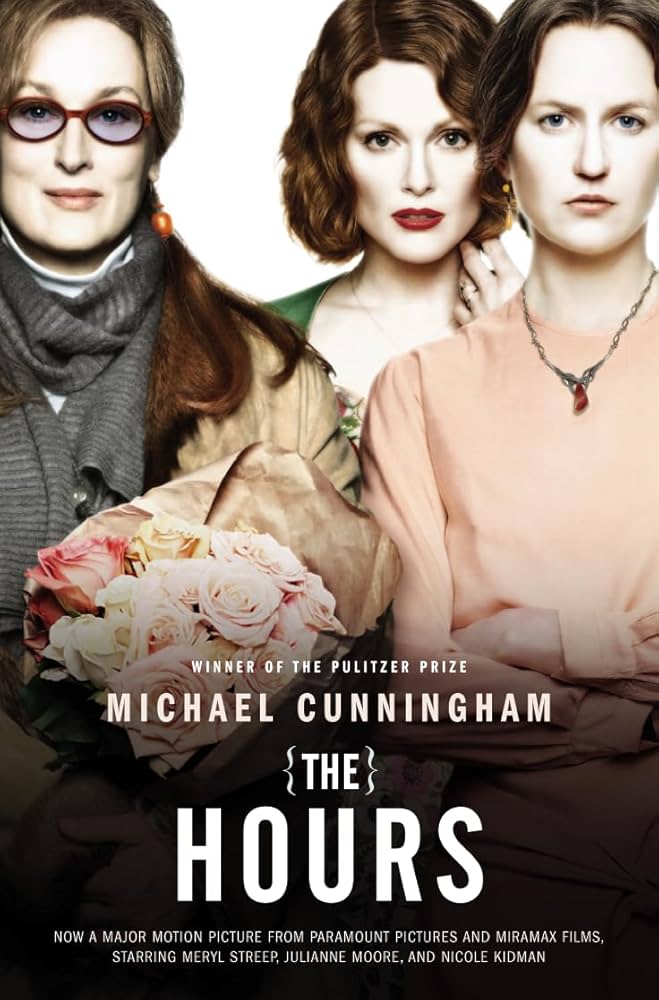
Seen the movie, wanted to read the book. What a load of posh suicidal ideation and Virginia Woolf boot licking… I can’t understand why people liked this book! The movie was better (gave it a 3/10)
Blurb:
The Hours is a daring and deeply affecting novel inspired by the life and work of Virginia Woolf. A passionate, profound and haunting story of love and inheritance, hope and despair. Exiled in Richmond in the 1920s, taken from her beloved Bloomsbury and lovingly watched over by her husband Leonard, Virginia Woolf struggles to tame her rebellious mind and make a start on her new novel. In the brooding heat of 1940s Los Angeles, a young wife and mother yearns to escape the claustrophobia of suburban domesticity and read her precious copy of Mrs Dalloway. And in New York in the 1990s, Clarissa Vaughan steps out of her smart Greenwich Village apartment and goes shopping for flowers for the party she is giving in honour of her life-long friend Richard, an award-winning poet whose mind and body are being ravaged by AIDS. These are the characters in Michael Cunningham’s exquisite and deeply moving novel, which takes Woolf’s life and work as inspiration for a meditation on artistic behaviour, failure, love and madness. Moving effortlessly across the decades and between England and America, Cunningham’s elegant, haunting prose explores the pain and trauma of creativity and the immutable relationship between writer and reader.
“What I wanted to do seemed simple. I wanted something alive and shocking enough that it could be a morning in somebody’s life. The most ordinary morning. Imagine, trying to do that.”
So the book starts with Virginia Woolf putting a stone in her pocket and going into the River Thames in London in order to painfully drown herself and let her body float against one of the bridges. Second story follows a bored housewife reading Mrs. Dalloway and then when going to bed with her husband in the same evening, she contemplates suicide because why not? She’s pregnant, has a child, a loving husband, why not kill herself as life is impossible to get any better than this. /s
Third story is about Clarissa who is spending pages and pages regretting her youth and how hot and desirable she was and now she’s planning a farewell party for a dying friend. Depressing and sad.
These three women have a loving family, loving friends and a purpose yet they all wallow in melancholy and dream of death not as a way out but as a statement that life has been lived to its purpose. FFS. I’m getting angry even typing this. First world problems everywhere.
After cycling to these two other women, we go back to Virginia Woolf who’s alive again, the suicide part was of course a bait that had to be put in the beginning because apparently it’s the most interesting part of her life, and she’s thinking of ideas for her new novel, Mrs Dalloway, initially titled The Hours.
Michael Cunningham parades us back and forth between these three storylines and it’s all so mundane and fogettable that you want to ditch this drivel and dust off your copy of Mrs Dalloway. The only thing this book has going for it is its relation to a famous writer. It has no discernible merit on its own. Even the melancholic, calming writing gets on your nerves very quickly and screams third-rate imitation.
I would say avoid this book and only read it if it’s in your required reading list for school in a study of suicide reasons.
A few jump out windows, or drown themselves, or take pills; more die by accident; and most of us are slowly devoured by some disease, or, if we’re very fortunate, by time itself. There’s just this for consolation: an hour here or there when our lives seem, against all odds and expectations, to burst open and give us everything we’ve ever imagined, though everyone but children (and perhaps even they) know these hours will inevitably be followed by others, far darker and more difficult.
And try to look at this book not as a Pulitzer prize winner but a money grab.
“Beauty is a whore, I like money better.”
― Michael Cunningham, The Hours
PS: There’s also this weird moment in which Cunningham describes an interaction between Woolf and her sister Vanessa: “Nelly turns away and, although it is not at all their custom, Virginia leans forward and kisses Vanessa on the mouth. It is an innocent kiss, innocent enough, but just now, in this kitchen, behind Nelly’s back, it feels like the most delicious and forbidden of pleasures. Vanessa returns the kiss.”
…
Then mrs. Woolf also thinks about this kiss years later and decides in her book that a kiss between women should happen again.
And there’s also this..
“Mary lingers a moment behind Julia, allowing herself a view of Julia’s broad, graceful back, the twin moons of her ass.”
… A la poubelle
