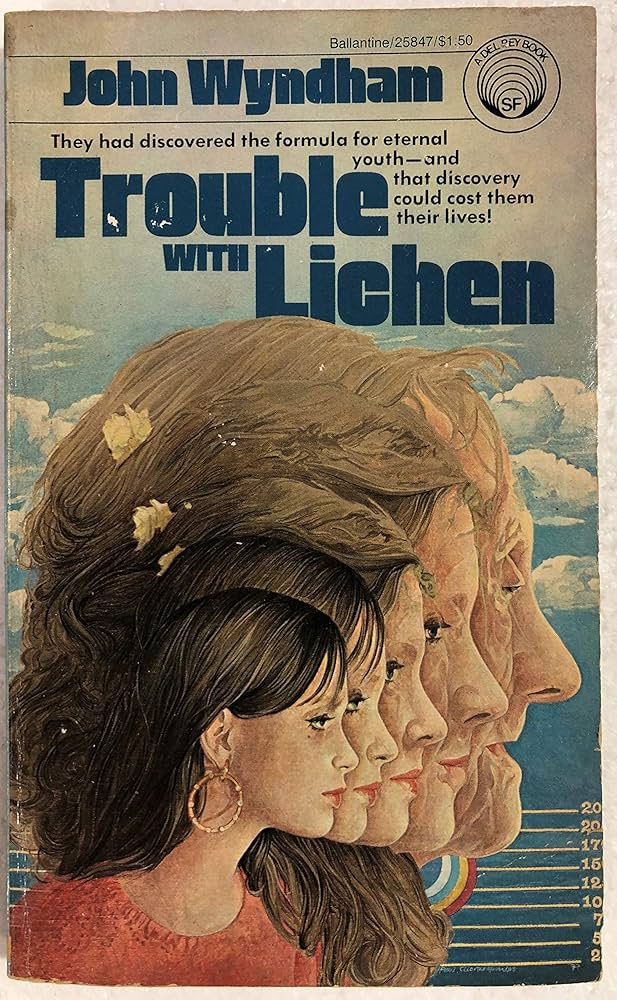
The sixth novel by prolific Sci-fi legend John Wyndham, and a return to the biological threat approach he first used in The Day of The Triffids. First published in 1960.
“[A] nation’s science simply has to keep up with the Jones’s these days.”
Even though this book is a classic, I must say it can apply to today’s times easily. It deals with the ethicality of giving medication to your own kin without disclosing what it is and what it does and the fallout. It also tackles the endless greed of people wanting to be immortal or just plain never age ever again.
The story is quite simple. Two researchers find a mysterious lichen and individually develop two bits of medication out of it. The lichen has the ability to slow down ageing to the point that someone given the “cure” can live to be 200.
The first researcher, after losing his wife, decides to inoculate both his daughter and his son on their 16th birthday with the anti-ageing compound. The second researcher builds a “youth” clinic in London called Nefertiti and is offering injections to well-paying customers that will make them feel and look younger.
It is all disclosed to the children when the clinic is sued by one of the customers after having an allergic reaction to the lichen and there is a possibility that part of the trial, the disclosure process would ask for the ingredients in Nefertiti’s special cream. They do manage to settle out of court for a hefty amount, but the media is intrigued. All of a sudden, the female employees of Nefertiti get boyfriends who are loosely or closely associated with the pharmaceutical industry. Requests for Interviews come in. People are digging for info as to what is the secret ingredient of their beauty treatments. And then it hit me – all of the customers were happy to be injected with unknown compounds as long as the effects were noticeable. None of them asked about the ingredient list.
How many times do you pick up a cream and read the back list? How many times do you go based on the packaging promising no wrinkles, no sun spots, fairer skin and possibly eye the main ingredient – vitamin C, seaweed, snail trails.
The children of the first researcher also run into some trouble – from the panic of knowing they will likely outlive their peers to the conundrum of the son who feels obliged to tell his wife as he doesn’t want to keep any secrets from her. The wife promptly goes to the father-in-law and requests the same treatment to be given to her immediately, and he dutifully obliges. It was a poor choice as she gives the lichen vial to someone else and pretends to her husband she took it.
So the question is – should the dad have informed his kids about what he’s giving them and let them choose? How about the profiteering part that the other researcher did? I mean all research has to serve humanity but to put a price tag on it so only the wealthy can benefit? Why not the entire population? Who wouldn’t want to live forever?
“I’m not romancing. I’m talking about the inevitable time when, unless we do something to stop it, men will be hunting men through the ruins, for food. We’re letting it drift towards that, with an evil irresponsibility, because with our ordinary short lives we shan’t be here to see it. Does our generation care about the misery it is bequeathing? Not it. “That’s their worry,” we say. “Damn our children’s children; we’re all right.”
When people are kidnapped and beaten to get to the source of the lichen, Nefertiti’s owner decides to hold a press conference and disclose what the main ingredient is.
Our deadliest susceptibility is conformity, and our deadliest virtue is putting up with things as they are.
I loved this book. The premise is immortality in a syringe and the questions it rises are valid even 60 years on. Are we ok to play God?