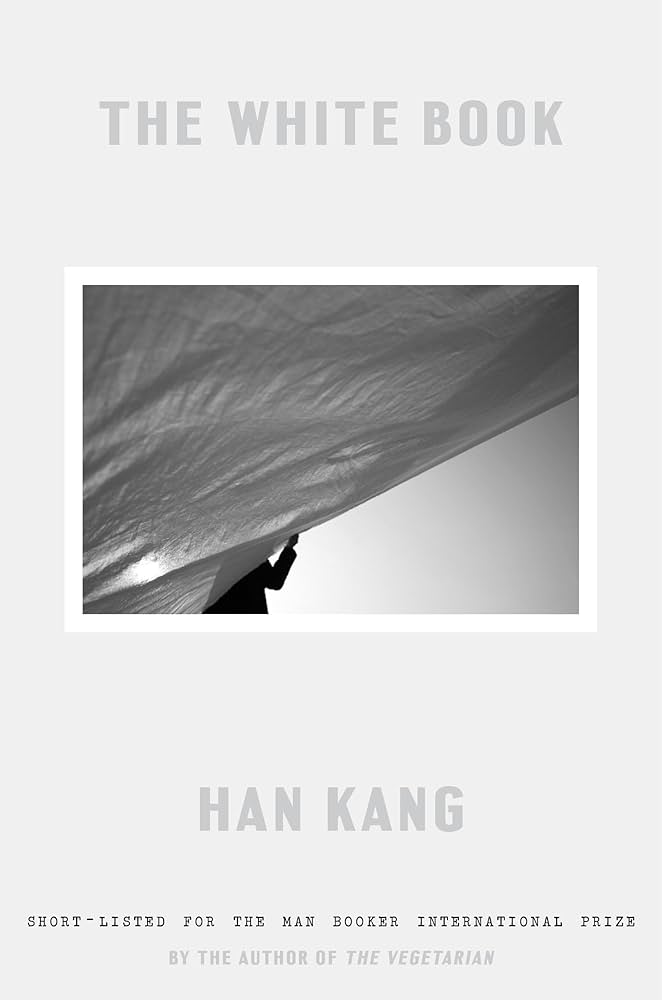
Shortlisted for the International Booker Prize, Han Kang’s The White Book is a meditation on colour, as well as an attempt to make sense of her older sister’s death, who died in her mother’s arms just a few hours after she was born. In captivating, starkly beautiful language, The White Book is a letter from Kang to her sister, offering a multilayered exploration of colour and its absence, and of the tenacity and fragility of the human spirit.
Each moment is a leap forwards from the brink of an invisible cliff, where time’s keen edges are constantly renewed.
From the Man Booker prize winner of “The Vegetarian” comes a new novel about grief and loss – written in first person about a woman who paints her apartment white.
Paint can in one hand, brush in the other, I stood unmoving, a dumb witness to the snowflakes’ slow descent, like hundreds of feathers feathering down.

The book is structured around the white things that become part of the rituals of mourning and remembering. Reflecting on a particular white pebble, Han notes: “If silence could be condensed into the smallest, most solid object, this is how it would feel.” The dominant theme is of transience, of fleeting life and the acceptance of human fragility. A snow storm in Warsaw erases the detail of its streets, yet when it falls on a black coat sleeve, it will “reveal its crystals even to the naked eye. Mysterious hexagons melting clean away.”
Now I will give you white things,
What is white, though may yet be sullied;
Only white things will I give.
No longer will I question
Whether I should give this life to you.
Some of the most affecting writing comes when the narrator speaks directly to her baby sister. “I wanted to show you clean things. Before brutality, sadness, despair, filth, pain, clean things that were only for you, clean things above all. But it didn’t come off as I intended. Again and again I peered into your eyes, as though searching for form in a deep, black mirror.”
All in all, the book is poetry, well written and a great study of pain, either through salt on a wound or a dissection of a mother’s loss of her pre-term child. Personally, I found it very sad, it made me sadder reading it and it’s not quite something I want when immersing myself in lecture. 10/10 for technical prowess and lyricism of the prose but 1/10 for mood booster.