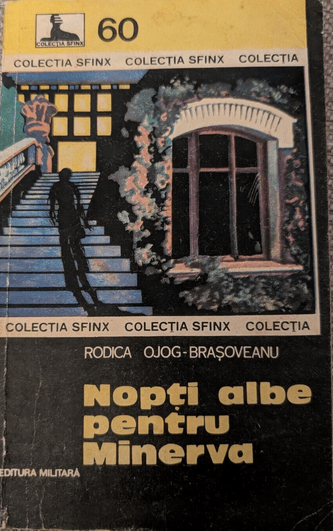
I have (yet again) raided my parent’s library and this time picked an interesting crime thriller called “Sleepless nights for Minerva”, following the major Minerva Tutovan (named after the goddess of wisdom in Roman myths).
I had to laugh when I found out that prior to joining the military, Minerva was a highschool teacher, feared by most and called The Samurai. What was even funnier, one of her students, Dobrescu Vasile, became her liutenant, despite his fears of never having been rid of her post-graduation.
Now back to the story:
Robbers take over an idyllic town, following a murder. Minerva, visiting it, fell in love with it from the first look.
“Almost all the houses are made of brick, have a small veranda, roofs with silver tiles and lack neighbors on the first floor. Bushes of pink hydrangeas and brumearias — I have never seen such large and beautiful hydrangeas anywhere — provide heavy shade for the dogs on personal property near the porch. In the center, located around a round square with a clock in the middle, are the most important buildings: the popular council, the library, the new supermarket and the “Alexandru cel Bun” high school. The clock, my friends claim, stopped on July 14, 1950, at exactly 2:31 p.m., the moment when the veterinarian Caracaş was seen swallowing the first glass of water in his career. In the high school yard, the former mayors erected a statue in memory of the first director of the college, D.D. Teodorescu. The locals designate the places in a succinct formula: opposite D.D.T., to the right of D.D.T. or in the house to the left of D.D.T.
Behind the high school, a complex of apartment buildings was built a few years ago for the employees of the aircraft factory, which is located a few kilometers from the city. The architect must have been a smart guy. He did not build skyscrapers or casemates, the buildings fitting perfectly into the landscape.
There is also a park, the legitimate pride of the citizens of P., where in spring the festivals of the county’s artistic brigades usually take place, and towards summer, when the grass lays a soft carpet, festivals for two.
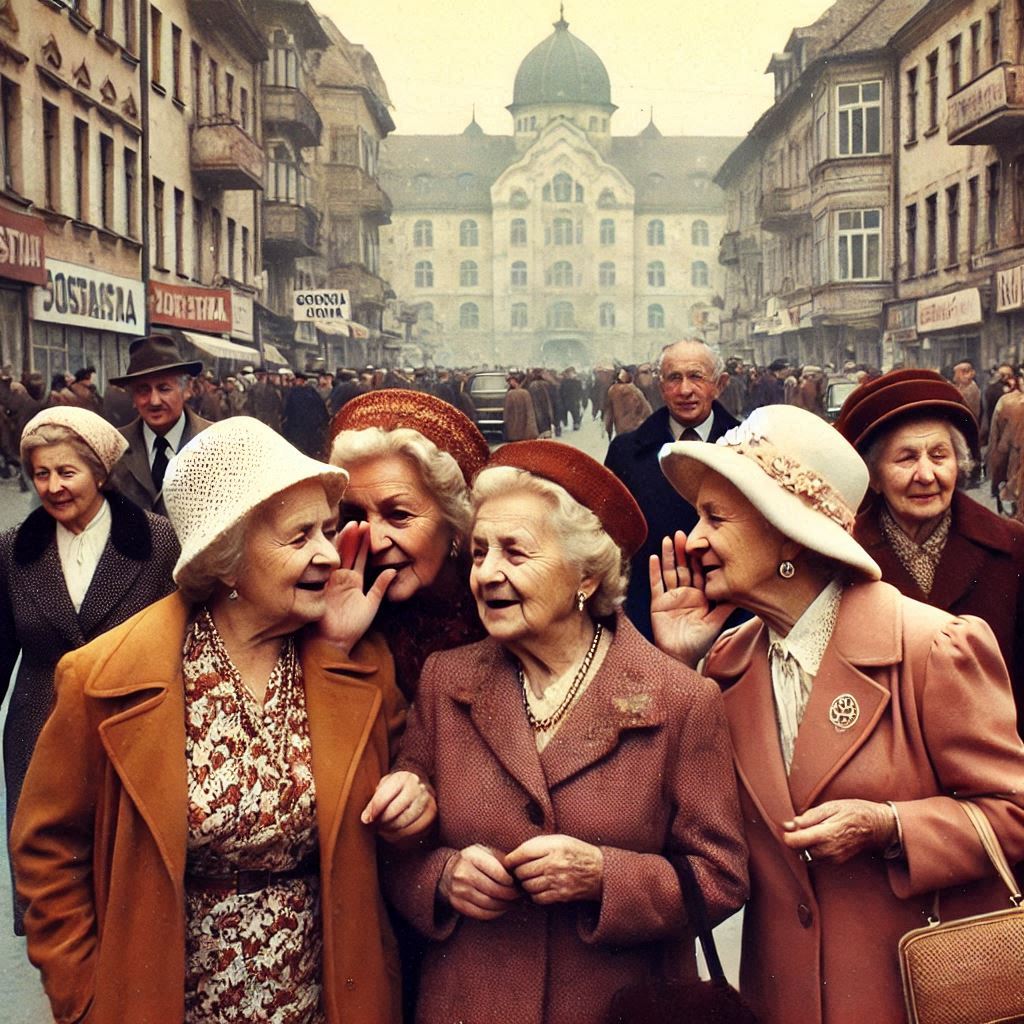
The people of P. have patriarchal customs. I value handwork, evenings spent watching television or at the literary club, and the exchange of opinions about fellow citizens, which takes place at the Igiena cooperative, where Misu Postolache is responsible. The building has no floors, and is located right in front of the market.
The source of the evil is unknown and panic quickly grips all the inhabitants who cannot fight the enemy. Everyone becomes a suspect and everyone hides a story that can be dangerous for others.
Who is behind the attacks?
People react unpredictably in crisis situations, truth and lies are confused, a small community can be full of surprises. Minerva Tutovan will try to unravel the tangles and identify the real robbers.
Mystery wise, the author admits through her main character, that she didn’t want to make it too easy for the reader. A good mystery will not be given away from the first few pages. There needs to be a little left for the brain to put together.
When I recapitulate the facts, I experience an acute sense of the fantastic and, without a doubt, the events in P. constitute the subject of the most fascinating case of my career.
A hallucinatory combination of dramatic and grotesque situations, a mixture of the most perfect ridiculous and authentic tragedies, a cocktail of buffoonery, hysteria, operetta tricks, nightmares and burlesque. Ignoring the hilarious clichés, you have the impression that you have watched a film by Hitchcock
The good parts:
- good description of a town that is not Bucharest (Rodica Ojog-Brasoveanu had an obsession with Bucharest as being the best town in the world and it was refreshing to read about a new place)
- The major’s description as a beast with maths was funny
The bad parts:
- the cast of characters is diverse and it gets tiring after a while to know who is who. We have a gym teacher, a barber, a married couple where the husband thinks his wife is cheating and is always trying to catch her in the act, the post-woman, local drunks, other teachers, a doctor, and the list goes on.
- Postolache, Atena Dumitrescu, Iliuţă Munteanu, Drojdioară or Romică Popescu. All confused, panicked or mentally impaired, obsessed and little bitches — see Dunăreanu. An admirable band, capable of turning your whole business upside down
- The women’s descriptions are yet again depicting them as either brainless or something .. less. Minerva is one of the shade throwers, seemingly disliking married lasses.
- “The unfortunate is totally depersonalized… How could God have managed to make this person? She is not beautiful, she is neurotic to the core, difficult, stingy, and from what she seems, not very orthodox in marital relations. She carries so many flaws on her back that you wonder she doesn’t walk hunched over.
- He took a few steps, trying to peer into the darkness. A discreet smile of satisfaction lit up his face. In less than five minutes, Doina will be here. Doina, towards whom Morogan himself expressed his admiration, Doina with black eyes and platinum hair in the shade of L’Oréal 9/1, Doina with the body of a faun and slender legs, Doina the most elegant girl in town, Doina, Doina… The coach was not exactly in love, he never had been, but pride prevented him from even mentioning in his mind Doina’s rather long and pointed nose, her faded chin, devoid of personality, her truly slender legs, but as the ladies at the market would say, “let’s not exaggerate, the poor girl simply can’t find stockings that fit, everyone is waving them around and no matter how much freshness they give you, you can’t spend your whole life in socks and with a tennis racket under your arm…”
 One Book a Week (Julia Reads Books)