I write this to be remembered. Will you judge me, in reading this? Who are you? Liar, cheat, lover, thief, husband, wife, mother, daughter, friend, enemy, policeman, doctor, teacher, child, killer, priest? I find myself almost more excited by you than I am by myself, whoever you might be.
My name is Hope Arden, and you won’t know who I am. But we’ve met before – a thousand times.
It started when I was sixteen years old.
A father forgetting to drive me to school. A mother setting the table for three, not four. A friend who looks at me and sees a stranger.
No matter what I do, the words I say, the crimes I commit, you will never remember who I am.
That makes my life difficult. It also makes me dangerous.

“I keep a blog.”
“I think I’ve read it.”
“Have you? Not many have – I should cherish you. Too many voices all at once on the internet, screaming, just all the time screaming, sometimes it’s hard to be heard. Sometimes I think that the world is full of screaming.”
I loved this book. I loved, loved, loved it. Hope is amazing and because the entire thing is written in first person, you feel like you’ve known her all your life, you’ve felt her pain. Because who would have thought that not remembering someone can cause pain to the person not being remembered? To be so easily forgettable that once your face is out of the frame, your existance ceases.
Hope had to leave school because her teachers didn’t remember her as being part of their class. Had to leave her home because her parents thought she was a stranger. She found herself on the streets with no money to her name.
You find the happiness you can, one said. Sometimes it’s hard, sometimes you gotta dig deep, but it’s there, the thing inside that you can be content.
But she slowly made a living. Since she was so forgettable, she could steal and nobody would be able to describe her or remember her to be honest. She becomes a thief. And she discusses her non-existance through really well designed medidative pieces.

All of thought is feedback and association. Faced with mounting social stress, the body responds as it would to any alarm. Capillaries constrict; heart rate elevates, breathing accelerates, skin becomes hot, muscles tight. Charm falters in the face of hypertension. From this moment of social rejection, pathways are reinforced in the brain to strengthen a link between socialising and anxiety. A series of assumptions develop which leads to a perception of social systems as threatening, triggering an anxiety response. All thought is feedback: sometimes that feedback can become too loud.
What are the real consequences of living a life where no one can remember you?
I stared at strangers who stared back, but no sooner are their heads turned than the memory begins to fade, and so they look
now
and now
and now
and each time they see me it is for the very first time.
And turn away.
I exist in this physical world as sure as stone, but in the world of men – in that world that is collective memory, in the dream-world where people find meaning, feeling, importance – I am a ghost. Only in the present tense am I real.
Turn thief, hacker, and be endlessly jealous of others who can at least have some way to define themselves by how others perceive them? This premise is much bigger than it first appears. This isn’t a super-power or a mild tale of the invisible woman. Hope is a complicated and rather brilliant woman who is absolutely free to do whatever she wants except for the one thing that’s denied her. Home, Love, and Hope.
The writing is excellent, the descriptions vibrant and colourful and so filled with soul that I can’t wait to pick up another book from this author.
For a while I counted cars; then I counted shrubs, then there was neither of either to count and I stared at dust and wondered how many grains of sand blew into the sea every year, and whether you could build a pyramid from them. The coast of Oman had been dug and sown with hardy dark green trees and thin, drooping beige fields, but the dust crept across every porch of every nowhere town that hugged the road.
What I also liked about the book was the app called Perfection. Think about that social app you’ve seen in the Black Mirror episode that pushes each user to to become their better selves with recommendations and rewards that gets so big that the whole damn world is enraptured by it. While Black Mirror worked on the concept of social credits, the Perfection app works on the concept that if a user does something like book a yoga class or eat a specific meal, they get perfection points. Multi-millionairs in perfection point are perfect people, based on the app’s definition of Perfect. Good teeth, good looks, money, charisma, involvement in arts, you name it.
“To make everyone better. All people. Perfection is just a lifestyle tool. Positive activities are rewarded, negative punished – nothing new. The treatments are the next step. You take an ordinary human mind, with all its flaws and fears, and impose upon it a…” a pause, a smile, Byron chuckling over the word, no humour in her laugh, “… a ‘better’ pattern. From doubt – confidence. From terror – bravery. Anxiety becomes ambition; humility becomes assurance. The treatments edit out the patterns of human behaviour which are considered imperfect, character flaws you might say, and replace it with a model of humanity that is… shall we say – and I think here we should – shall we say ‘perfect’? The perfect man. The perfect woman.
I am sure that if such an app did exist, people would flock to it, like they did in the book. Everybody is insecure about something or wanting to improve on a feature. This constant desire for self improvement is what makes us human. It’s what makes us – us.
Just because you have forgotten me, does that mean I am not real?
Now.
You forget.
Now.
I am real.
Reality: the conjectured state of things as they actually exist.
I breathe, and in the time the air takes to leave my lungs, I vanish from the minds of men, and cease to exist for anyone except myself.

What’s even more Black Mirror is that I didn’t realise that Hope was of African-American descent. I thought she was just another white girl, disappearing in the sea. But she’s beautiful and she’s real and she’s definitely not white. And Hope is not Perfect. She doesn’t have the app and she wants to hack it to pieces and tore it up and bring down the order. And while doing so, she wants to break society in their pursuit of the next great thing.
The physical reinforces the social. Through very few cycles, we may become convinced of fallacies. That we are afraid of people. That we are worthless. You and I could be perfect, if only we could tame that weakest part of ourselves – our thoughts.
Towards the end, the book philosophises on nihilism. What’s the point of it all. Why bother? There’s this natural desire to be remembered, if not for ourselves then for our actions. For someone whose ability to make an impression is stripped away, that can be psychologically devastating, and in Hope we see the full range of those effects. What’s the value of personhood, after all, if no one can remember you long enough to appreciate it?
If you forget the joy of this day, then what joy you give to others will also be forgotten, and your life has no consequence, no meaning, no worth. I am a shadow, blasted away by the sun, a meaningless occlusion of light that fades with the day.

Where had I come from? Where was I going?
From nowhere, to nowhere.
The past was just a present that had been, the future was a present yet to come, and only now remained, and I stood by the sea, recovering my land-legs from the road, and wept.
I wept too, Hope, I wept too.
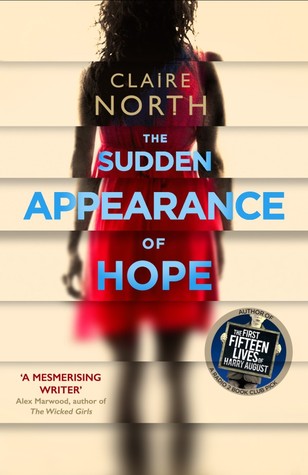
The Sudden Appearance of Hope ended up being everything I expected from a novel by Claire North: original, entertaining, and hard-hitting. Her stories are always so different, which may or may not work depending on the kind of reader you are. I never know whether her books will run hot or cold for me, so it was nice to dive into this audiobook and come out on the other side with a very positive experience. I enjoyed this one a lot!
Here’s some of my favourite quotes:
- When you are alone, even the quiet is full of monsters.
- To destroy Perfection. What if thought is not free? What if memory is a prison, society a lie?
- Know thyself, and know everyone else. Having no one else to know me, having no one to catch me or lift me up, tell me I’m right or wrong, having no one to define the limits of me, I have to define myself, otherwise I am nothing, just a… liquid that dissolves. Know yourself.
- Thought can travel through time, you see, memory reinvents itself, making the past something that always has been, now, in this second, now, for ever. You can’t ever really trust your own memory, your own mind.
- I am memory; I am the sum of my memories.
- I am the sum of my deeds.
- I am thoughts for the future.
- Compilations from the past.
- I am this moment.
- I am now.
- Knowledge. What should I do with this place inside me where experience – tears of joy, shrieks of laughter, the anxiety of work, the warmth of friends, the love of family, the expectations of the world – what should I do with that place which was never filled? I put knowledge there. And in knowledge, I find myself.
- You choose your own perfect. You choose to be who you are, and the world cannot shape you, unless you permit it. The world cannot move you, unless it is by your own welcoming in. You are free, Hope. You are more free than anyone living
- How can anyone live with it? How can anyone live with so much screaming in their lives, all the time? Matheus Pereyra loved the screaming. I guess these days people love to feel themselves burn


Leave a comment