From the award-winning author of The Vegetarian comes a riveting and poetic examination of humanity at its most appalling, and its most hopeful.
“It happened in Gwangju just as it did on Jeju Island, in Kwantung and Nanking, in Bosnia, and all across the American continent when it was still known as the New World, with such uniform brutality it’s as though it is imprinted in our genetic code.”
As I listened to the audiobook version I kept thinking .. where’s the plot? The triggering event? This book starts after a shocking and terrible event has happened and the first few chapters only deal with dead bodies and their identification process. The next few chapters deal with a ghost’s POV and spend a LOT of time musing about the structure of a soul – whether it’s bird like, whether is has eyes or not. Don’t get me wrong, the book is very lyrical but you can’t help but feel bored and ask yourself: where is the interesting part?
“After you died I couldn’t hold a funeral,
So these eyes that once beheld you became a shrine.
These ears that once heard your voice became a shrine.
These lungs that once inhaled your breath became a shrine.”
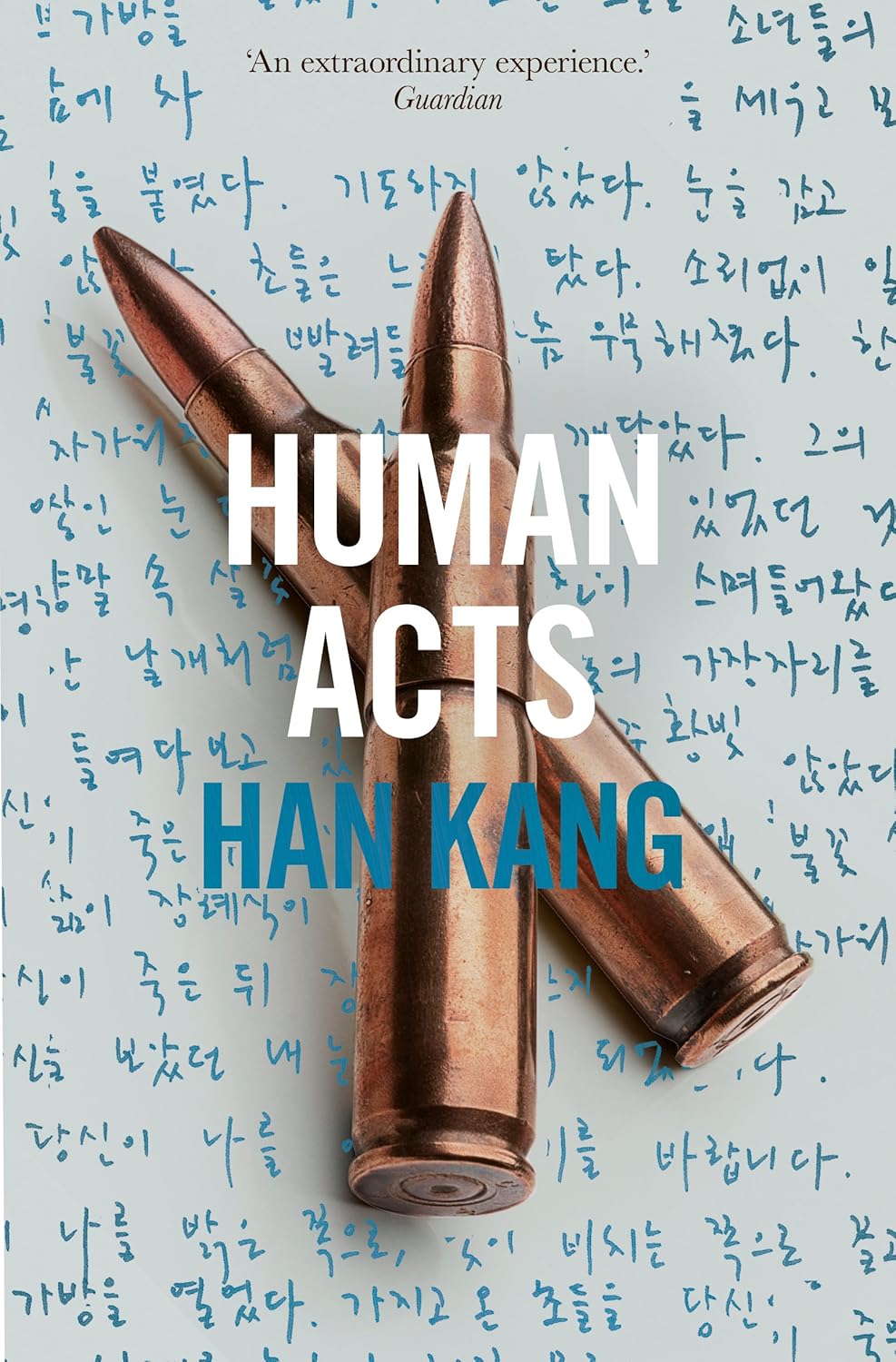
The book covers the South Korean Gwangju Uprising in 1980 – where school kids (middle schoolers and even high school kids) were brutally beaten by the police / army and killed and then sent to mass graves. You get to hear all about the corpses, their different stages of decay and bearing the marks of violence thrust upon them. You hear about a toothless old man coming from the mountain to find his grandchildren – a mute boy and a girl. He had heard rumours that the soldiers had beaten a mute boy quite brutally and didn’t know if he was the same boy or not.
All of the chapters, though connected, feel like individual stories. I jumped around from perspective to perspective, never coming to feel an attachment to any character or their story.
However the execution was horrendous. Split up into 6 parts, the narration is difficult to follow and the writing style is not fluid. Kang also utilizes the second person. Why?! Extreme mental gymnastics is required to figure out what the hell is going on. But it’s possible that the translator, Deborah Smith, also may have botched some wordings. For the most part, the book was definitely a slog. I felt like I was forcing myself through parts.
Is it true that human beings are fundamentally cruel? Is the experience of cruelty the only thing we share as a species? Is the dignity that we cling to nothing but self-delusion, masking from ourselves the single truth: that each one of us is capable of being reduced to an insect, a ravening beast, a lump of meat? To be degraded, slaughtered – is this the essential of humankind, one which history has confirmed as inevitable?
I think the purpose of this book was to showcase the good and the bad that humans do to each other. The cruel and the kind, the acts of mercy and the acts of violence – sometimes only a few hours apart.
I was horrified about the young boy, who had feminine features, who was tortured by being stripped naked and placed face-down in an ants nest and he was nibbled in his genital area.
“I never let myself forget that every single person I meet is a member of this human race. And that includes you, professor, listening to this testimony. As it includes myself.”
Murakami had a similar approach about the subway bombing in Tokyio – a desire to capture the unthinkable that had happened and leave a trace of the tragedy for humanity. Thankfully, it was better executed.
 One Book a Week (Julia Reads Books)