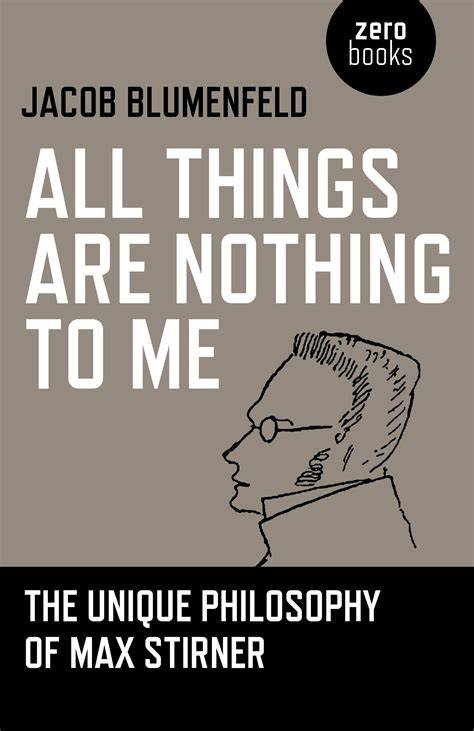
Max Stirner’s ( “Max Stirner” is the pseudonym of Johann Kaspar Schmidt) Der Einzige und sein Eigentum (1844) is the first ruthless critique of modern society. Misunderstood, dismissed, and defamed, it is now time to unearth this savage book once more. My aim is to reconstruct the unique philosophy of Max Stirner (1806–1856), a figure that strongly influenced—for better or worse—Karl Marx, Friedrich Nietzsche, Emma Goldman as well as numerous anarchists, feminists, surrealists, illegalists, existentialists, fascists, libertarians, dadaists, situationists, insurrectionists and nihilists of the last two centuries.
Stirner’s anti-moral, anti-political, and anti-social philosophy is especially in vogue today, in a hyperpolarized, post-crisis world where god, government and the good have all died, replaced by technology, markets and private interest.
Blumenfeld undertakes his reconstruction of Stirner as a contemporary in four steps: in the first part of the book, titled ‘Stirner’s Revenge’, he develops a methodological framework; in the second part, ‘Stirner’s World’, he gives a reading of Der Einzige und sein Eigentum. The third and by far longest part, ‘My Stirner’, consists of a comprehensive reinterpretation of Stirner’s thinking and places it within the discourse of modern philosophy. In the last chapter, ‘All Things are Nothing to Me: Stirner, Marx and Communism’, Blumenfeld finally sums up his interpretation and argues for the relevance of Stirner today.
Blumenfeld commences with a rejection of all attempts to read Stirner not as a thinker in his own right but solely as a historical figure within the development of the history of ideas or social history in a broader sense, e.g. as a petty bourgeois ideologist or as a disciple of Hegel. Blumenfeld is surely right in claiming that if Stirner is interpreted at all, most of the time it happens in exactly this manner. Instead, he wants to take Stirner serious as ‘a practical philosopher, one who develops a whole grammar for living which fears no death.’ (16) This move transposes Stirner into an entirely different plane – and even changes the plane of history of philosophy itself: ‘[T]he history of philosophy needs to be redrawn so that Stirner’s text finds its proper place, side by side with Spinoza’s Ethics, Nietzsche’s Genealogy, and Levinas’s Totality and Infinity.’ (16f.) Moreover, Stirner should be read as a Stoic similar to Marcus Aurelius and Seneca.
For me the book was a miss, tried to read it, didn’t get 90% of it. Bin.
 One Book a Week (Julia Reads Books)