Some things are so bad that just to have been near them taints you, leaves a spot of badness in your soul like a bare patch in the forest where nothing will grow.
You know how they say that fishermen tell long tales? Well, this one is no different. I went into this book blind, having only heard that it’s about a story within a story and I thought – something like The Wind Through The Keyhole * Stephen King (Dark Tower). I was wrong. This was way darker, way more convoluted and way more disturbing than any Stephen King novel.
With each year that passed, I came to ask myself if Marie might not have gone out of this world so much as gone more deeply into it. From being wrapped up in earth, maybe she’d made her way out into it, into the soil, the water, until she was part of things. Maybe she’d found a way to lead me back to her.
The writing is full of melancholy, what if’s and unasked questions. It’s a story as much about grief as it is about the supernatural and the world beyond.
Some parts were a bit wild and hard to swallow (took a star off for those) but the rest is a beautiful story like the type you hear in a tavern from some old veterans in the fishing business.
Dan lost his entire family in a freak accident – his wife and two daughters. Our storyteller lost Marie, his wife, after a long sickness.
It’s hard to hold onto any tragedies that aren’t your own for very long. That’s something I learned after Marie died. In the short term, folks can show compassion like you wouldn’t believe; wait a couple of weeks, though, a couple of months at the outside, and see how well their sympathy holds.
Dan and our fellow find solace in fishing together, going to catch some on Saturdays, not really talking much, just enjoying each other’s solitude and own thoughts.

They say that, for most people, the second year after you lose someone is harder than the first. During that first year, the theory goes, you’re still in shock. You don’t really believe what’s happened to you has happened; you can’t. During that second year, it starts to sink in that the person—or, in Dan’s case, people—you’ve been pretending are away on a visit aren’t coming back
Grief is a hell of a thing. You can’t fully explain it to someone who has never lost anything of value. It lingers, it demands to be heard and worst of all, it makes you do things you otherwise wouldn’t have done.
When there are some premonition dreams, they ignore them but it’s only when Dan requests to go fishing in a very odd place, the fears start appearing. And a bartender on the way there is warning them not to go, as many people have died there:
That’s the problem with telling stories, though, isn’t it? After the dust has settled, when you sit down to piece together what happened, and maybe more importantly how it happened, so you might have some hope of knowing why it happened, there are moments, like the dream, that forecast subsequent events with such accuracy you wonder how you possibly could have been deaf to their message. Thing is, it’s only once what they were anticipating has come to pass that you’re able to recognize their significance.
Funny thing is, while he was telling his tale, I believed much more than I would have guessed likely. Only once his voice had stopped was I convinced I’d just been buried under the greatest load of horseshit anyone ever had shovelled. Yet even after Dan and I had paid for our meals and left the diner and were continuing our drive to the creek, it was as if I were still listening to Howard’s voice, as if I were inside his story, looking out at everything, as the story uncoiled around me.
If I say there was more truth to Howard’s tale than I first believed, I don’t suppose it’ll come as much surprise. What I find almost as remarkable is that I can recall pretty much everything Howard said, verbatim. Given what was to happen to Dan and me, maybe that isn’t such a surprise.
Gotta love those stories with an omniscient writer. You know he’ll survive to still write it down but what ever happened to him and Dan? It all comes back to the bartender’s story. A guy called Rainer used to live in those parts and he talks about a panhandler that came there and promised to help save the landowner’s daughter. She died but the panhandler stayed on and people kept on whispering about him – his odd ways, the heavy chains that he would sink in the water and then occasionally check them.
He was fishing. After a bit of guess work, the people came up with the answer.
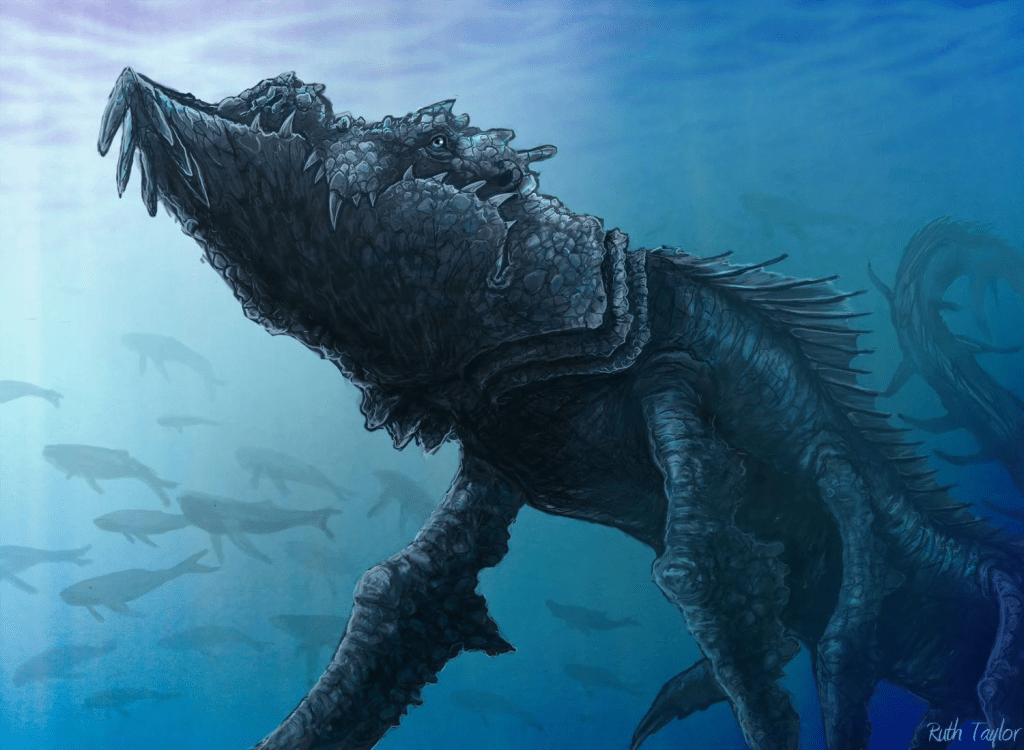
“Because the man wants to catch one of the Great Powers.”
“What Great Power?” Italo says. “Do you mean a devil?”
“No,” Rainer says. “This is something else. The old Egyptians spoke about it as a great serpent with a head of flint, a thing of darkness and chaos.” Seeing the looks the other men give him, Rainer sighs and says, “It is what Scripture calls Leviathan.”
The story becomes even weirder as people come back from the dead and walk, giving visions of a drowning hell and a massive beast looking to pull people under.
The stories continue with urban legends of taxi drivers ferrying the dead to their resting place and stories of unrequited love.
I don’t mind saying, I was feeling a tad story’d-out. First Howard’s extravaganza, and now Dan’s more restrained example, and in the meantime, a human skull wrapped in translucent skin was grinning at me over a mouth of fangs. “So that’s how you found out about this place,” I said. “Great. Now—”
“‘Saw Eva,’” Dan said. “That’s why we’re here.”
The truth slowly comes to the surface. The reason why Dan wanted to fish in this specific spot, where worlds nearly touch, was because the dead could travel through the thin veil.
In their approach to the forbidden lands, the author meets the imprisoned fisherman, tied for centuries to a rock, unable to fulfil his destiny of catching the large fish.
There was only absence, a void as big and grand as everything. It wasn’t white, or black; it wasn’t anything. Perfect in its nothingness, its nullity, it had been contravened, somehow, sundered, confined to the form before me. Imprisoned, but not separated, it was the black ocean, and the pale creatures grasping the lines that held it, and the Fisherman tied to his rock, and me. To understand this, to appreciate it, might be the beginning of a kind of wisdom.
And the mirage brings forth actual creatures looking like the departed. Dan chooses to believe these sharp-fanged illusions and stay with them (probably to become food).
It’s just, you think all those hours sitting beside one another, watching the water of this stream or that slide by, waiting for a fish to take our bait, making small talk and occasionally bigger talk—you think all of that would count for something, that the fact of it would weigh against the fantasy that tempted him.
The author decides to leave and then tell this story but you can’t help but wonder if this is not yet another fisherman’s tall-tale and Dan had actually done the unthinkable and this is maybe just one way left to honour his memory – by thinking of him together again with his beloved wife and daughters in a realm beyond our own.

 One Book a Week (Julia Reads Books)