DNF.
Yes, doing science requires values; but the facts thus obtained are not themselves values. The facts that men are on average taller than women, or that tests show that African Americans have lower average IQ than white Americans, are equally value neutral. But human nature being what it is, the second fact is likely to elicit much stronger emotions than the first, even though both are just facts. Neither one impels us to action, unless we feel, as a value, that some race or gender differences are a bad thing.
Most of the book was written like this, extremely difficult to follow, author jumping from one thought idea to another. I bought it thinking the 4.3 stars on Amazon and 3.5 stars on Good Reads meant something but I was completely bored. The author argues that theories cannot be proven, talks about religion and facts in the same breath and attempts to re-introduce some ideas that are at least a century old and outdated. Massive let down.
As eighteenth century philosopher David Hume showed many years ago, science consists of facts, but facts alone do not motivate. Without motive, a fact points to no action. Liddle was right, however, in this: both religion and secular humanism do provide motives, explicit in one case, but covert in the other.
I found that the author referenced David Hume a lot in his writing. It’s very good when you’re writing a science book to have more than one source of information.
- The issue should have been settled by David Hume in 1740: the facts of science provide no basis for values. Yet, like some kind of recurrent meme, the idea that science is omnipotent and will sooner or later solve the problem of values seems to resurrect with every generation.
- Philosopher David Hume perhaps convinced Gibbon that the facts of science are provable but the “facts” of religion for the most part are not. They are matters of faith, not science. There is no scientific evidence for the truth of Christianity.
- This is why philosopher David Hume separated “ought,” the dictates of morality, from “is,” the facts of science. Reason is value-neutral, Hume argued:
- It is not contrary to reason to prefer the destruction of the whole world to the scratching of my finger. It is not contrary to reason for me to chuse my total ruin, to prevent the least uneasiness of an Indian or person wholly unknown to me.
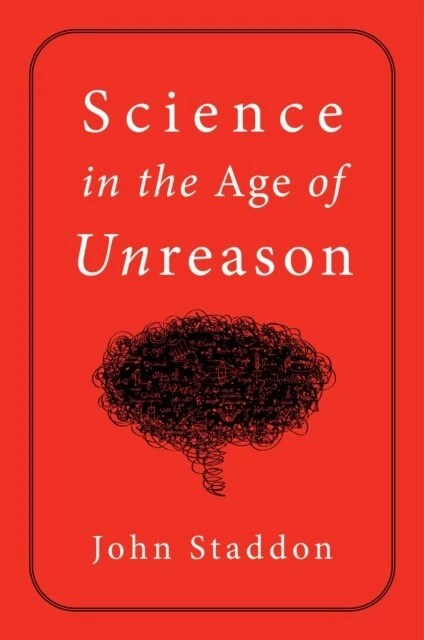
Book Blurb
Science is undergoing an identity crisis! A renown psychologist and biologist diagnoses our age of wishful, magical thinking and blasts out a clarion call for a return to reason and the search for objective knowledge and truth. Fans of Matt Ridley and Nicholas Wade will adore this trenchant meditation and call to action.
Science is in trouble. Real questions in desperate need of answers—especially those surrounding ethnicity, gender, climate change, and almost anything related to ‘health and safety’—are swiftly buckling to the fiery societal demands of what ought to be rather than what is. These foregone conclusions may be comforting, but each capitulation to modernity’s whims threatens the integrity of scientific inquiry. Can true, fact-based discovery be redeemed?
In Science in an Age of Unreason, legendary professor of psychology and biology, John Staddon, unveils the identity crisis afflicting today’s scientific community, and provides an actionable path to recovery. With intellectual depth and literary flair, Staddon answers pressing questions, including:
- Is science, especially the science of evolution, a religion?
- Can ethics be derived from science at all?
- How sound is social science, particularly surrounding today’s most controversial topics?
- How can passions be separated from facts?
Informed by decades of expertise, Science in an Age of Unreason is a clarion call to rebirth academia as a beacon of reason and truth in a society demanding its unconditional submission.
 One Book a Week (Julia Reads Books)