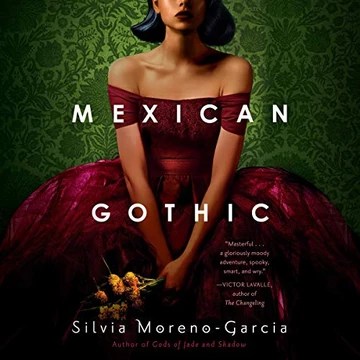
Weheeey, another great gothic read but this time with a cultish, mushroom lover, nearly immortal, eugenics enthusiast bad guy (who guess what? was English) facing a young, off this world, Mexican young socialite with a taste for anthropology.
I absolutely loved the decor! The old, musty, dusty house at the top of the hill (much like the Bates motel or Rose Red), hiding secrets like Craven Manor.
The people inhabiting the house are old and the servants silent. They don’t talk much during dinner. The curtains are drawn like awaiting death. There is tragedy in the past and there is also a larger-than-life mystery enveloping the Doyle family.
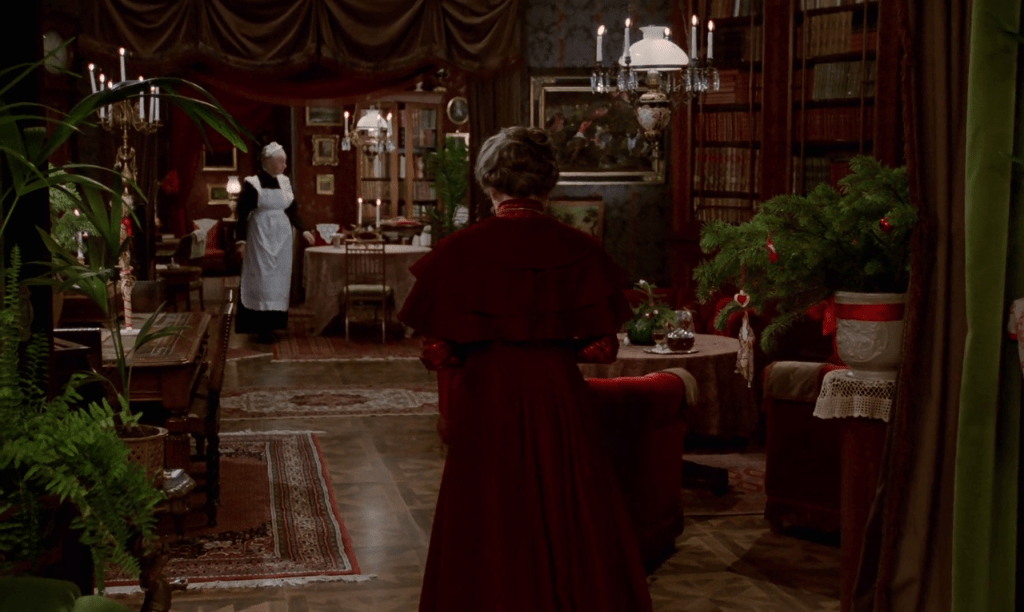
Then, all of a sudden, they were there, emerging into a clearing, and the house seemed to leap out of the mist to greet them with eager arms. It was so odd! It looked absolutely Victorian in construction, with its broken shingles, elaborate ornamentation, and dirty bay windows. She’d never seen anything like it in real life; it was terribly different from her family’s modern house, the apartments of her friends, or the colonial houses with façades of red tezontle.
The story is much like What Moves the Dead by Ursula Vernon and The Yellow Wallpaper (Catalina Perkins Gilman).
It starts off with a series of mysterious letters received by Noemí’s father from his niece, Catalina, a cousin of his daughter and sensing distress, he contacted the husband. The husband gave him the runaround and in irritation and concern, he sent his beloved daughter to sniff out what’s going on, promising her something she’s really been looking for – further education in a time where women did not get education.
It looks like Noemí’s got a real chance to apply her wits as the people who she meets are weird. There’s Francis, the youngest of the family and mostly the one doing all the chores. There’s Virgil, Catalina ‘s husband. He’s the only son of the patriarch of the family – Howard – set to inherit everything. There’s Henry’s sister and Francis mother – Florence, an old woman whose husband had died a tragic death by falling to his death ages ago. There’s a lot of death in this family.
Howard Doyle is the decrepit head of the household, extremely sick but still holding on to life with an iron will.
“What are your thoughts on the intermingling of superior and inferior types?” he asked, ignoring her discomfort.
Noemí felt the eyes of all the family members on her. Her presence was a novelty and an alteration to their patterns. An organism introduced into a sterile environment. They waited to hear what she revealed and to analyze her words. Well, let them see that she could keep her cool.She had experience dealing with irritating men. They did not fluster her. She had learned, by navigating cocktail parties and meals at restaurants, that showing any kind of reaction to their crude remarks emboldened them.
“I once read a paper by Gamio in which he said that harsh natural selection has allowed the indigenous people of this continent to survive, and Europeans would benefit from intermingling with them,” she said, touching her fork and feeling the cold metal under her fingertips. “It turns the whole superior and inferior idea around, doesn’t it?” she asked, the question sounding innocent and yet a little bit mordant.
Her spark is what draws attention to her as a possible replacement (oh, that sounds gross) for the ill wife, Catalina , who seems to be suffering from a nervous breakdown and has been under house supervision (arrest) for months.
“There is a doctor. His name is Arthur Cummins. He has been our physician for many years. We completely trust Dr. Cummins.”
I trust this doctor as much as I trusted Silas Weir Mitchell (the same doctor who instituted wellness rest mandatory for nervous women (The Yellow Wallpaper And Selected Writings (Charlotte Perkins Gilman) 1892). Noemí doesn’t either and she asks for a second opinion from another local doctor. The family is irate that she would barge in – as a stranger – and dictate what they should do with regards to one of their own – Catalina had married into the family so she was no longer a Taboda. They go along with it due to Noemí’s last name and her father’s connections and they ensure she is lively when the other doctor visits.
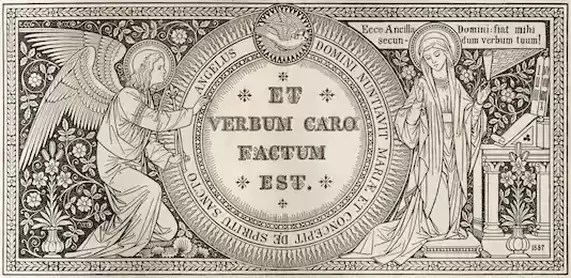
Et Verbum caro factum est.
“And the Word became flesh” and is a key phrase from the Gospel of John, specifically John 1:14, referring to the incarnation of Jesus Christ.
Things start getting weirder and I started suspecting foul play from the family in order to ensure Catalina was docile and the impressive doury she brought with her, in good use in ressurrecting the mines that the family lost and bringing them back to their former glory. This type of marriage is not unheard of – alliances where an old name with no fortune marries a nouveau riche without the old name in order to get money. The spouse gets recognition. The problem is that Catalina got a really bad deal. She married and instead of a happy wife, she became a prisoner in and old and silent house, where the closest village was at the foot of the hill and the only social company she got was old and strict.
In a corner of her room there was a bit of mold upon the wallpaper that caught her eye. She thought of those green wallpapers so beloved by the Victorians that contained arsenic. The so-called Paris and Scheele greens. And wasn’t there something in a book she’d read once about how microscopic fungi could act upon the dyes in the paper and form arsine gas, sickening the people in the room?
She was certain she’d heard about how these most civilized Victorians had been killing themselves in this way, the fungi chomping on the paste in the wall, causing unseen chemical reactions. She couldn’t remember the name of the fungus that had been the culprit—Latin names danced at the tip of her tongue, brevicaule—but she thought she had the facts right. Her grandfather had been a chemist and her father’s business was the production of pigments and dyes, so she knew to mix zinc sulfide and barium sulfate if you wanted to make lithopone and a myriad of other bits of information.
Well, this comes back later on as we find out that the house is riddled with fungi and mould. And this decrepitude also seems to seep into the morals of the people living there. Virgil, a married man, is hitting on her. The octagenary is also making lewd remaks about her strong body and possible good genes – even though her line of “Mexican” lineage is impure and thus lower than his own.
Men would be solicitous and well behaved when they courted a woman, asking her out to parties and sending her flowers, but once they married, the flowers wilted. You didn’t have married men posting love letters to their wives. That’s why Noemí tended to cycle through admirers. She worried a man would be briefly impressed with her luster, only to lose interest later on. There was also the excitement of the chase, the delight that flew through her veins when she knew a suitor was bewitched with her. Besides, boys her age were dull, always talking about the parties they had been to the previous week or the one they were planning to go to the week after. Easy, shallow men. Yet the thought of anyone more substantial made her nervous, for she was trapped between competing desires, a desire for a more meaningful connection and the desire to never change. She wished for eternal youth and endless merriment.
Well, it seems that everyone in this family wants the same thing. And they went around and played with mycellium to get it. Much like in the book What Moves the Dead – the fungi are alive and sentient – and they are both hallucinogenic and have healing properties.

It was not a haunting. It was possession and not even that, but something she couldn’t even begin to describe.
All in all it’s a good book and I would love to see a movie adaptation for it.
 One Book a Week (Julia Reads Books)