I love this dude’s books. I started off slow with Arrival: Film tie-in book by Ted Chiang and continued with Exhalation by Ted Chiang. When I saw this in the e-book store, I went and got it, thinking maybe I wouldn’t have read all of it, all of what there is.
Includes the story collection:
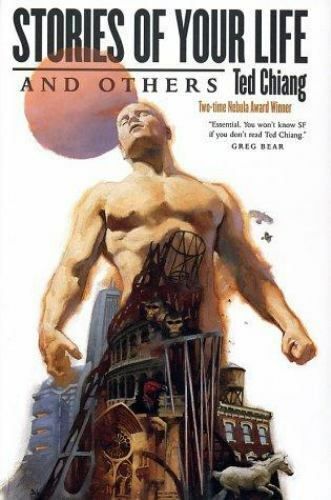
Stories of Your Life and Others (2002)
Tower of Babylon (1990) – Read in Arrival
Understand (1991) – loved this in Arrival. There are several psychologists at the hospital studying me now. It’s interesting to see how they analyze my intelligence. One doctor perceives my skills in terms of components, such as acquisition, retention, performance, and transfer. Another looks at me from the angles of mathematical and logical reasoning, linguistic communication, and spatial visualization. [..] The psychologists have the opportunity to gain some insight into my thinking through their interviews, but they can’t shed their preconception of me as someone out of his depth, an ordinary man awarded gifts that he can’t appreciate. Reminded me a little of Flowers for Algernon * Daniel Keyes
Division by Zero (1991) – Read in Arrival. Dividing a number by zero doesn’t produce an infinitely large number as an answer. The reason is that division is defined as the inverse of multiplication: if you divide by zero, and then multiply by zero, you should regain the number you started with. However, multiplying infinity by zero produces only zero, not any other number. There is nothing which can be multiplied by zero to produce a nonzero result; therefore, the result of a division by zero is literally “undefined.”
Story of Your Life (1998) – The Actual Arrival Story. There’s a joke that I once heard a comedienne tell. It goes like this: “I’m not sure if I’m ready to have children. I asked a friend of mine who has children, ‘Suppose I do have kids. What if when they grow up, they blame me for everything that’s wrong with their lives?’ She laughed and said, ‘What do you mean, if?’ “That’s my favorite joke.
As for this story’s theme, probably the most concise summation of it that I’ve seen appears in Kurt Vonnegut’s introduction to the 25th anniversary edition of Slaughterhouse-Five: “Stephen Hawking… found it tantalizing that we could not remember the future. But remembering the future is child’s play for me now. I know what will become of my helpless, trusting babies because they are grown-ups now. I know how my closest friends will end up because so many of them are retired or dead now… To Stephen Hawking and all others younger than myself I say, ‘Be patient. Your future will come to you and lie down at your feet like a dog who knows and loves you no matter what you are.’ “
Seventy-Two Letters (2000) – Read in Arrival compendium as well. It was a good re-read. Nor was there a single “true name” for a given object: depending on its precise shape, a body might be compatible with several names, known as its “euonyms,” and conversely a simple name might tolerate significant variations in body shape, as his childhood marching doll had demonstrated.
Stories in which the golem is used as a servant to perform chores— with varying degrees of success— originated in the 1500s, but they still aren’t the oldest references to the golem. In stories dating back to the second century, rabbis would animate golems not to accomplish anything practical, but rather to demonstrate mastery of the art of permutating letters; they sought to know God better by performing acts of creation. The whole theme of the creative power of language has been discussed elsewhere, by people smarter than me. What I found particularly interesting about golems was the fact that they’re traditionally unable to speak. Since the golem is created through language, this limitation is also a limitation on reproduction. If a golem were able to use language, it would be capable of self-replication, rather like a Von Neumann machine.
The Evolution of Human Science (2000) – Read. What if humans became sub-humans if meta-humans were invented and would have to live from the translatable scraps of information they produced. Short and sweet.
This short-short was written for the British science journal Nature. Throughout the year 2000, Nature ran a feature called “Futures;” each week a different writer provided a short fictional treatment of a scientific development occurring in the next millenium.
The future is already here; it’s just not evenly distributed.
Hell is the Absence of God (2001)
I haven’t read this one and oh, my, God. What a world in which revelations and angel sightings and miracles were the way. In this world, the heavens open and Angels go from plane to plane, sometimes giving a person who has never walked good legs, sometimes blinding people until their cheeks meet their foreheads. People in this world sway from one side (God is here to punish you for something you’ve done to God is here to bless you for something you’ve done. The problem comes when a person who was absolutely content with their lives receives a gift and when another person receives none. They decide to go on a pilgrimage together to the holy sites.
Every holy site had its pilgrims who, rather than looking for a miracle cure, deliberately sought out Heaven’s light. Those who saw it were always accepted into Heaven when they died, no matter how selfish their motives had been; there were some who wished to have their ambivalence removed so they could be reunited with their loved ones, and others who’d always lived a sinful life and wanted to escape the consequences.
At an instinctual level, Neil was averse to the idea: it sounded like undergoing brainwashing as a cure for depression.
Welcome to religion! I am agnostic, I don’t pray, don’t believe with that devotion in an afterlife. I think in that sense I’m like Neil.
The entire idea had an all-or-nothing quality to it that Neil found both frightening and attractive. He found the prospect of going on with his life, trying to love God, increasingly maddening. He might try for decades and not succeed. He might not even have that long; as he’d been reminded so often lately, visitations served as a warning to prepare one’s soul, because death might come at any time. He could die tomorrow, and there was no chance of his becoming devout in the near future by conventional means.
Liking What You See: A Documentary (2002)

What an interesting concept. What if people couldn’t tell who was hot or not. Who was attractive, who was average. What if everyone looked the same? The story is about lookism and a technical implant called calli.
The deeper societal problem is lookism. For decades people’ve been willing to talk about racism and sexism, but they’re still reluctant to talk about lookism.
All animals have criteria for evaluating the reproductive potential of prospective mates, and they’ve evolved neural “circuitry” to recognize those criteria. Human social interaction is centered around our faces, so our circuitry is most finely attuned to how a person’s reproductive potential is manifested in his or her face. You experience the operation of that circuitry as the feeling that a person is beautiful, or ugly, or somewhere in between. By blocking the neural pathways dedicated to evaluating those features, we induce calliagnosia.
You see, the foundations of our culture were laid in classical Greece, where physical beauty and the body were celebrated. But our culture is also thoroughly permeated by the monotheistic tradition, which devalues the body in favor of the soul. These old conflicting impulses are rearing their heads again, this time in the calliagnosia debate.
What would you pick? Body or soul? Or is it true the soul shines through whatever physical appearance the person has? Or maybe it’s just looks for some. The dilemma of the story is whether the beautiful person and the other admiring it consent to it. And the possibilities are endless. If you can enhance the way someone reacts to an image,making them more compelling, what will stop them from making everyone we see on screens extraordinary, each actor fantastic, each commercial magical. We would be ordinary and boring in real life and we’d have to rely on digital enhancers to feel desirable.
Nothing erases the past. There is repentance, there is atonement, and there is forgiveness. That is all, but that is enough
Plus:
What’s Expected of Us (2006)
There have always been arguments showing that free will is an illusion, some based on hard physics, others based on pure logic. Most people agree these arguments are irrefutable, but no one ever really accepts the conclusion. The experience of having free will is too powerful for an argument to overrule. What it takes is a demonstration, and that’s what a Predictor provides.
What if there were a device showing the world that there is no free will? If your choices don’t matter, why make them?
… pretend that you have free will. It’s essential that you behave as if your decisions matter, even though you know that they don’t. The reality isn’t important: what’s important is your belief, and believing the lie is the only way to avoid a waking coma. Civilization now depends on self-deception. Perhaps it always has.
Welcome to nihilism.
The Merchant and the Alchemist’s Gate (2007)
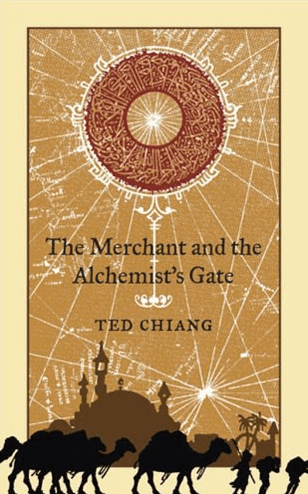
Read. A series of stories within a story, told in the style of Sheherezade and 1001 Arabian Nights. What would happen if people get to talk to their other selves and travel through a portal to other times.
I realize now that, even though the past is unchangeable, one may encounter the unexpected when visiting it.
Do you now understand why I say the future and the past are the same? We cannot change either, but we can know both more fully.
[…] you cannot avoid the ordeals that are assigned to you. What Allah gives you, you must accept.
Four things do not come back: the spoken word, the sped arrow, the past life, and the neglected opportunity
Exhalation (2008)
Every day we consume two lungs heavy with air; every day we remove the empty ones from our chest and replace them with full ones.
So starts a weird story of a reality where air (argon) was inhaled via replaceable lungs which could be shared between people. The filling stations is the place to be if you just want to talk to other people and share the same air.
For the filling stations are the primary venue for social conversation, the places from which we draw emotional sustenance as well as physical.
Lungs can travel between cities, even between remote places and the filling stations are the gossip centres of the world.
And as you’re reading, you realise that the storyteller is a robot (encased in tin, with gold foil for brain memory storage) who then starts to disect its own brain and ponder on their chromium encased universe.
Even though our universe is enclosed, perhaps it is not the only air chamber in the infinite expanse of solid chromium. I speculate that there could be another pocket of air elsewhere, another universe besides our own that is even larger in volume. It is possible that this hypothetical universe has the same or higher air pressure as ours, but suppose that it had a much lower air pressure than ours, perhaps even a true vacuum?
The Lifecycle of Software Objects (2010
Read in Arrival. Very good story about the sexualisation of digients, like avatar pets in the virtual reality world. And about rights of sentient AI and becoming a person.
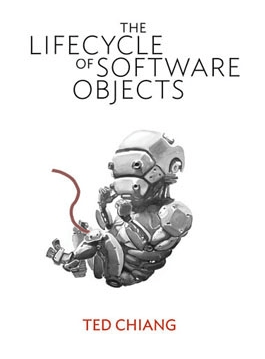
But surely the AI will be able to learn faster because it won’t be hampered by emotions, right? On the contrary, I think creating software that feels emotions will be a necessary step towards creating software that actually thinks, in much the same way that brains capable of emotion are an evolutionary predecessor to brains capable of thought. But even if it’s possible to separate thinking from feeling, there may be other reasons to give AIs emotions. Human beings are social animals, and the success of virtual pets like Tamagotchis demonstrates that we respond to things that appear to need care and affection. And if an AI takes years to train, a good way to get a human to invest that kind of time is to create an emotional bond between the two.
 One Book a Week (Julia Reads Books)