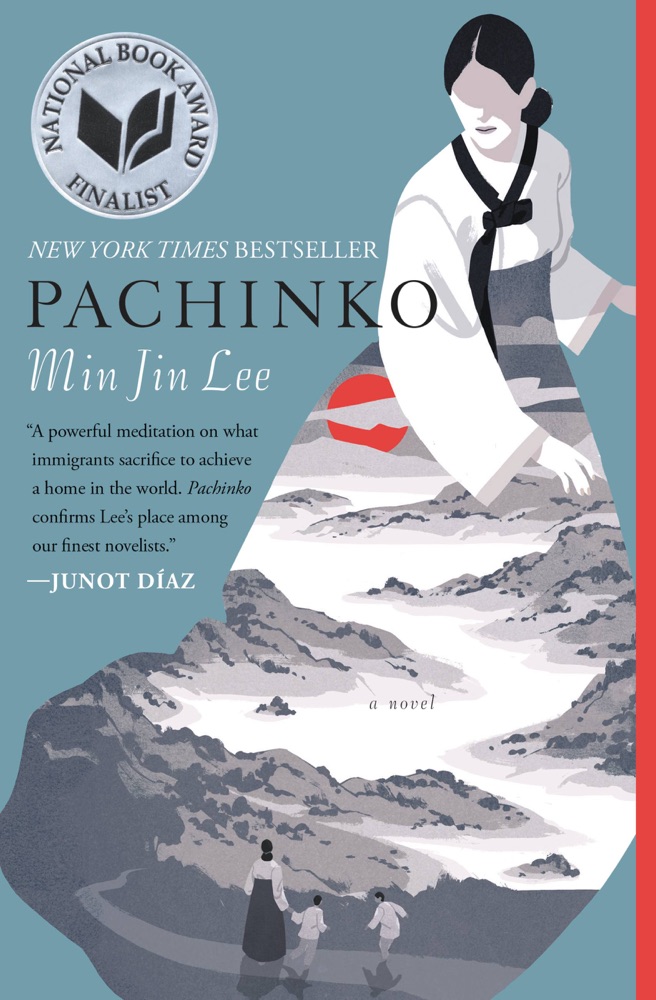
What a ride this book has been! It took several months to go through it and it was worth it. It follows several generations, a single mother marrying to avoid the shame, moving from occupied Korea to Osaka, Japan and raising two boys in a new country based on new rules. The boys are Noah and Mozazu and due to some unforeseen findings, one of them passes (trigger warning: suicide). The story then follows Mozazu’s boy as he migrates to America and then comes back to have a chat with his family as part of his business.
She could not see his humanity, and Noa realized that this was what he wanted most of all: to be seen as human.
‘This is a captivating book… Min Jin Lee’s novel takes us through four generations and each character’s search for identity and success. It’s a powerful story about resilience and compassion’
BARACK OBAMA.
Yeongdo, Korea 1911. In a small fishing village on the banks of the East Sea, a club-footed, cleft-lipped man marries a fifteen-year-old girl. The couple have one child, their beloved daughter Sunja. When Sunja falls pregnant by a married yakuza, the family face ruin. But then Isak, a Christian minister, offers her a chance of salvation: a new life in Japan as his wife.
Following a man she barely knows to a hostile country in which she has no friends, no home, and whose language she cannot speak, Sunja’s salvation is just the beginning of her story.
Through eight decades and four generations, Pachinko is an epic tale of family, identity, love, death and survival.
The book was so good it even received an Apple TV series adaptation and has been renewed for a second season
I would have said it’s a slice of life book but it’s a bit more. It follows the ending of the second world war, the strong nationalist Japanese nation who view Koreans as second-class citizens, the disreputable notion of mixed blood and how Koreans have managed to succeed against all odds in a very unfriendly country.
There is love, there is marriage, there is a strong family bond between two sister-in-laws who become more like blood sisters than anything else. I loved the book.
And I can understand some of the longing they felt as an immigrant myself, you always want to try and go back from the country you left just to see if it has changed or not. The quote below is from a mob boss’s second in command proposing a union to the sister-in-law after her husband turns to alchool.
“I’ve made her suffer so much. She loved me when I was just a boy. I always knew that we’d be together, even when we were kids. She was the most beautiful girl I had ever seen. You know, I’ve never wanted to be with another woman. Ever. Not just because she’s so lovely, but because she’s so good. Never, not once, did she complain about me. And I have not been a husband to her for such a long time.” He sighed. His mouth felt dry. “I know you care for her. I trust you. I wish you didn’t work for that thug, but there aren’t that many jobs here. I understand. Why don’t you just wait until I die?” The more he said these things, the more Yoseb felt that it was right. “Stay here. I’ll die soon. I feel it. You’re needed here, too. You can’t fix that country. No one can.”
“You could come with me. The first ship leaves next week, but we can go later. Korea needs more people who have the energy to rebuild a nation. We’re supposed to get our own apartment with all the latest appliances, and we’ll be in our own country. White rice three times a day. We can take his ashes there, and we can visit your parents’ graves. Do a proper jesa. We can go home. You can be my wife.”
We never feel history being spoon-fed to us: it is wholly absorbed into character and story, which is no mean feat for a novel covering almost a century of history. You learn about foods they eat, prices in the markets, the smart way of selling sweets to commuters, the importance of side-dishes like kimchi and ways to pickle cabbage.
The book is long and sometimes complex, it wears its research lightly, and is a page-turner. You can sense the author’s love and understanding for all the characters, the good and the flawed
About the Author
Min Jin Lee is the bestselling author of two novels. Pachinko was a finalist for the National Book Award for Fiction, a New York Times bestseller and was included on over 75 best books of the year lists. It is currently being adapted for television by Apple TV. Lee’s debut novel Free Food for Millionaires was a Top 10 Books of the Year for The Times, NPR’s Fresh Air and USA Today. Min Jin Lee’s writings have appeared in The New Yorker, the TLS, the Guardian, Conde Nast Traveler, The Times and the Wall Street Journal, among others. In 2019, Lee was inducted into the New York Foundation for the Arts Hall of Fame. She serves as a trustee of PEN America, a director of the Authors Guild and on the National Advisory Board of the Immigration Initiative at Harvard.
 One Book a Week (Julia Reads Books)