I’ve read this in my teens but the time has come for it to be under scrutiny once more.
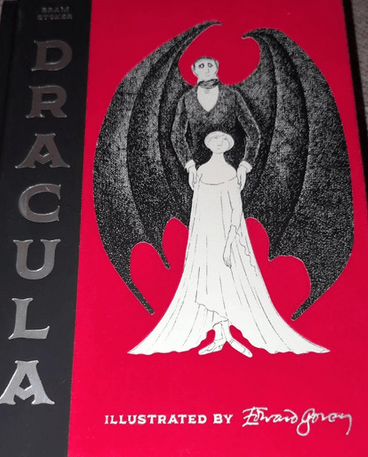
I was lucky enough to find a limited edition print of the book and it even contained a bit of history of how the book came to be and another unpublished novel.
Margaret Atwood made a note for Dracula : Oh Dracula, unlikely hero. Stephen King mentioned the unded in Salem’s Lot.
There’s also Twilight and Anne Rice – Interview with the vampire.
But now to the original hero:
The Horrifying Count Who Just Won’t Die
“I am Dracula, and I bid you welcome, Mr. Harker, to my house. Come in; the night air is chill.”
You know the character, of course; you’ve seen him throughout your life—in cartoons, on cereal boxes, in countless movies and TV shows, and, later, teaming up with other creature-feature stars like Frankenstein and the Wolf Man, squaring off against good guys from Sherlock Holmes to Buffy the Vampire Slayer. But have you ever actually read Bram Stoker’s Victorian horror classic, Dracula? Why not?
You’re probably familiar with the outlines of the story: A centuries-old vampire lures an English visitor to his castle in Transylvania, then journeys to London to seek fresh blood from his visitor’s paramour—with first mystified, then terrified, and finally horrified pursuers on his trail. But what you may not know is how the formal structure of Stoker’s storytelling adds to the suspense. The initial chapters of the book are told through the journals of the Englishman who makes the trip to the count’s eerie Transylvanian lair, and the rest of the novel portrays the growing fears and awareness of an extended circle of characters through letters, telegrams, newspaper stories, diary entries, and even transcriptions of early phonographic recordings. As episodes and revelations are pieced together, the reader’s apprehension mounts with the discovery of each new wound, corpse, and coffin.
Stoker, an Irishman with a love for the stage (for years he managed the London theater company of celebrated actor Henry Irving), based the character of Dracula on elements of Eastern European vampire legends. Although he was not the first to turn such lore to literary profit, his addition of a veiled eroticism and a looming personality—along with a few new qualities, such as his vampire’s lack of reflection in a mirror—created an undead villain for the ages, one who still runs rampant through a century of spin-offs.
 One Book a Week (Julia Reads Books)