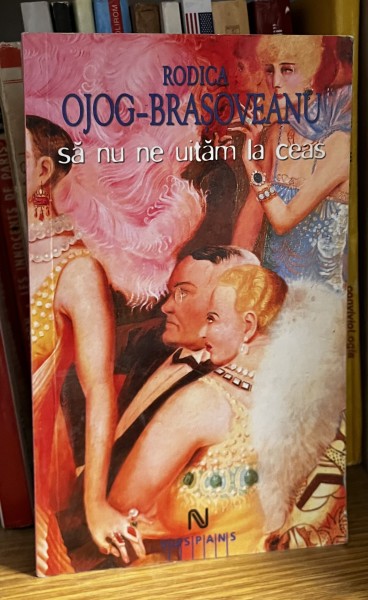
I’m slowly going through my mother’s library and this time I picked another book from a very prolific writer from the ’80s. Set in 1940’s Bucharest, the story follows a diverse cast of characters involving Romanian spies, a German Nazi general, a mysterious woman and the general’s wife and her lover and a few other mistresses looking to obtain legitimacy.
„Elvira Manu surâse amintirii. Agenții naziști îl scutiseră pe colonel să facă eforturi pentru a simula culorile autenticului. Dimpotrivă, se ivise problema securității vieții Elvirei. Ticu Stratulat, agent proaspăt recrutat pe atunci, ca și ea, și mai cu seamă bătrânul Duca se dovediseră paznici de nădejde. Prințul activa în serviciul secret încă din timpul celuilalt război. Avea o răfuială veche de familie cu boche-ii. Fratele său, căpitanul de stat-major Anton Duca, capturat de ostașii lui Wilhelm, fusese asasinat după torturi bestiale. Ștefan ar fi iertat și poate uitat glonțul primit bărbătește, din față, pe câmpul de luptă. Crima odioasă însă, comisă în beciurile poliției militare germane din Cluj, se cerea plătită. Nu putea fi uitată în sipetul cu scrisori vechi de familie…“
I read it and I can’t say I liked it. The story was a convoluted mess of who’s sleeping with who and Elvira is described as a 40-something classy lady in comparison with a slew of much sluttier women, either high-born or low born. There’s a lot of brand name dropping – what type of cigars were the men smoking, what type of suits did they wear. The make and model of the blue chiffon dress. The perfume – mostly occidental brands. The hotel bath robes. And the list goes on.
I found it tiring to be reading a dialogue and then a list of adjective describing the loveliness or the depravity of the woman involved. Men downtalking women a lot – apparently in order to get a good wife, she needs to be pale and almost sick with tuberculosis and float from place to place like a ghost (actual line in the book).
Also women need to be seen not heard and Elvira is a smart chick and “despite that” she gets the Nazi general to fall for her.
The twist at the end was that she was also a secret agent planted by the Romanian security in order to get the general to divulge where Hitler was building a secret weapon’s base and to stop it in order to win the war.
Good points:
- I’ve had to Google a lot of brand names and actor names that were dropped as part of the conversation to see how they looked like. Good bit is that I’ve seen some really nice 1940s dresses from Dior.
- The food and drink is also described in detail and again, I had to Google some drink Elvira had in Dobrogea as the name was unfamiliar to me and that’s how I found Boza
- Kurt von Sundlo is a very nice guy and it made me laugh reading his thoughts and see him behave like a true gentleman.
- Some of the descriptions of Bucharest are lovely and it makes me want to visit the Capital again (don’t go in winter, it’s grey and depressing)
- Makes me want to visit parts of Romania I haven’t seen like Dobrogea and other sea side towns.
- Mornings are early on the coastside. Towards five in the morning, the cold breadth extinguishes the spread of sparkling stars; slender fingers are raking them in the blue veil of the night. Somewhere, beyond the lace curtains, beyond the orange palm trees who are keeping watch over the promenade, far away in the sea, where no ship has yet travelled to, the sun is opening its bloody eyelid.
Bad points:
- to the people who would have bought this book when it came out in 1989, it would have been a treat to read it. All about the occidental brands that were nearly unheard of during the Communist regime. Now, not so much. It’s really galling the amount of time the story is detoured to make a small commercial for cigarettes.
- The side plot with the mistress looking to get married to her already married lover didn’t really go anywhere or add to the plot.
- The men’s views on women range from despising the heavy walks and the swearing to putting beauty on a pedestal and willing to do anything for a pretty face.
- Aristide Stanescu watched her with a hungry look – a censured hunger of a well-trained dog – the body he knew in its smallest of details, and which continued today, two years from their first time together, to stir him. A rock-hard body, statuesque, of a healthy woman, with long muscles, strong, with no shadows or soft parts. “She has got everything she needs, the experts agreed, how much and in what places”
The ending is a bit sad. After faking her own death, Elvira sees the (former) Nazi general in Paris and before she gets up the courage to go and talk to him, she takes her time to watch him and seeing him more as a decrepit old man, she feels pitty and changes her mind. She made this poor man fall in love with her and then broke his heart making him belive she was dead. Didn’t correct it when she had the chance…
Meh, this one is going in the recycling bin.

 One Book a Week (Julia Reads Books)