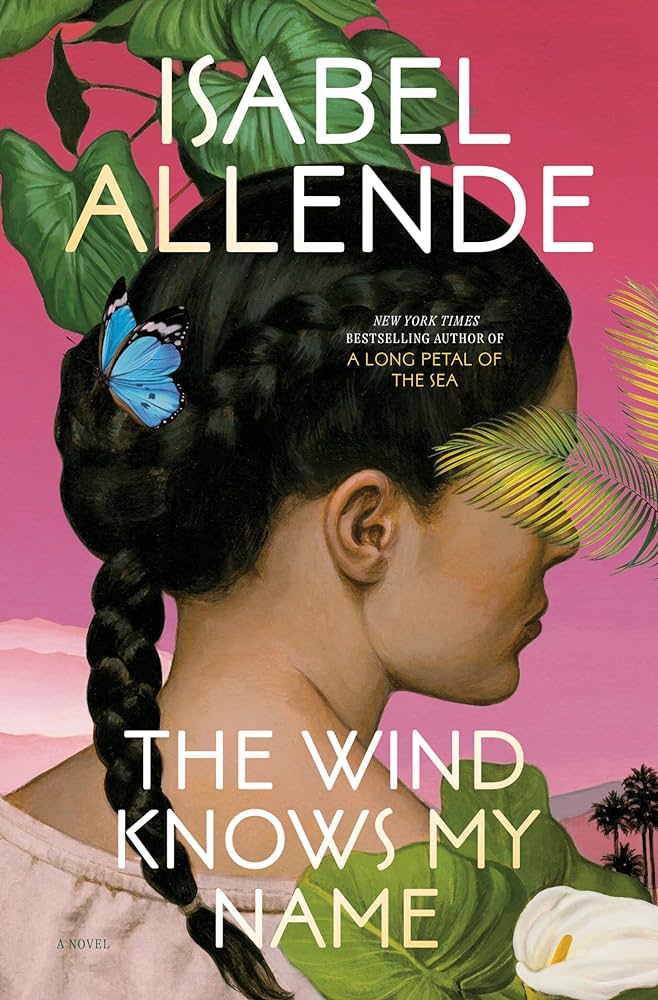
Picked up this book in my local bookshop because I really liked the cover – and again, I went blind inside as I knew nothing of the author and was curious to see what the buzz was about.
Spanning across nearly a century, Isabel Allende is using her penmanship skills to bring to light a current issue – the displacement of children during war times.
I had no idea. I thought it was about the life of a Jewish boy who barely escapes recently occupied Austria at the start of the second World War. Imagine my confusion when a few chapters later and a jump in time, I am reading the story of a San Salvador immigrant’s daughter. And then in another jump in the 2000’s, the story of a woman trying to fight for the rights of children in detention centres in Texas.
I was miffed. I liked the first story and a bit of the second, but as the book wore on, so did my attention. It was told in such a boring way! So much detail and no soul. Some of the elements were repeated in different phrasing across the stories.
“Well, that’s not the American government’s problem.”
“It is, actually, because the American government is at least somewhat responsible for the mess these countries are in. During the Cold War, the United States tried to end all leftist movements in Central and South America by arming, indoctrinating, and training brutal militaries; they knowingly financed government repression. Here, we justified it as the ‘expansion of democracy,’ but it did exactly the opposite. The U.S. government overthrew democratically elected leaders and imposed vicious dictators; the only thing they were actually defending was the business interests of American companies and the super wealthy.”
Umm, OK.
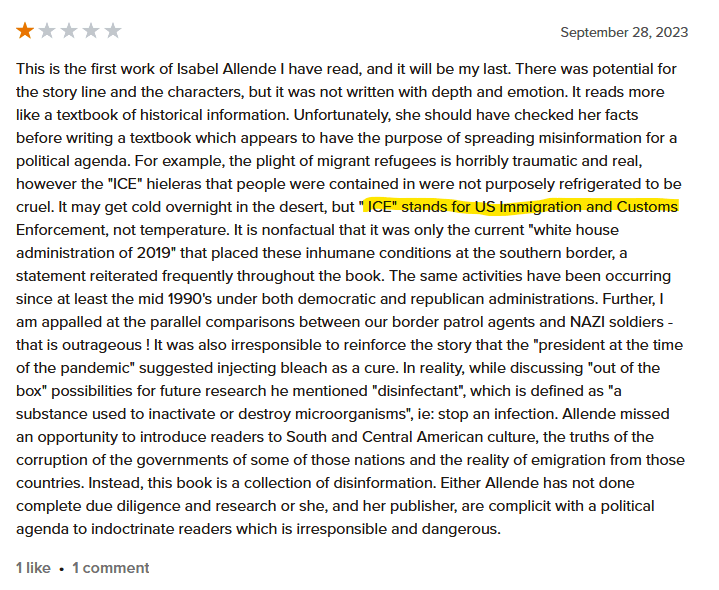
What started off as a potentially good story, turned very quickly into a “hot topic” debate on immigration and pushing (quite strongly) a political agenda.
Immigration was a hot-button topic, and engaging with it might bring a lot of headaches, but Frank knew that Lambert would’ve weighed the risks. He was impressed by the young woman’s calm eloquence and felt embarrassed that he hadn’t paid more attention to the tragic fiasco playing out at the border.
OK, OK. So you can see based on the above why I removed two stars. I also took half a star off for Covid & the pandemic. It’s ok if you reference 2020 and what happened then, but you don’t have to include it in such detail. We lived it, we know it. We don’t want to read about it anymore. (Stephen King’s Holly book pissed me off as well for doing the same thing)
The clubbering of the reader with “this is what you should care about” and the 5th grade level writing put me off.
That saying, the book does have its merits. Some of the scenes have a whiff of humour about them that made me chuckle when reading. For example,
Her boyfriend, plumber by trade and alcoholic by vocation, got Leticia a fake birth certificate that said she was two years older, so that they could marry.
Hah!
So for now, I’ve selected a few “representative” quotes of the clubbering, designed, I think, to make you feel bad about the plights of others, but done in such a way you don’t really care. Our Missing Hearts, Celeste Ng was a LOT better in talking about displacement of children and the state interfering in domestic affair compared to this book.
Years later, Leticia tried to find out as much as possible about that terrible December in 1981 that had forever marked the course of her life. Over a decade would pass before the truth was revealed little by little, because neither the government of El Salvador nor the United States wanted the world to learn the details of what had happened in El Mozote and other villages of the region. Theydenied the massacre, impeded investigations into the events, and assured the impunity of the murderers. The bloodbath had been perpetrated by a military operative trained by the CIA at the infamous School of the Americas, in Panama, to combat insurgents from the Farabundo Martí National Liberation Front. For years, the United States intervened in Latin American politics to defend their economic interests in the region, facilitating cruel repression. In reality, it was a war against the poor, just as had happened in other countries during the Cold War. It was a systematic attempt to root out any and all leftist movements, especially the guerillas.- There were no guerillas in El Mozote, only farmworkers from the village and surrounding areas who flocked there in search of safety when the soldiers flooded in. But there was no safety to be had. That day, December 10, the soldiers of the Atlacatl Battalion arrived in the remote region by helicopter and occupied several villages in a matter of minutes; the objective was to terrorize the rural population to keep the people from supporting the insurgents. The following morning the soldiers began by separating the men to one side of the village and women to the other; the children were sent to the rectory, which they called “the convent.” They tortured everyone, including the children, trying to glean any information; they raped the women and murdered every living soul. Some were shot, others were stabbed with knives or machetes, some were burned alive. The children were run through with bayonets or slaughtered with machine guns, and then the convent was burned to the ground. The little charred bodies trapped inside were unrecognizable. With the blood of a murdered child they wrote a message on the wall of the school: One dead child, one less guerilla. They also killed the animals and set fire to the houses and fields. Then they left, leaving only blazing coals and bodies strewn across the ground.
Selena told Frank that in one of her brief telephone conversations with Marisol, she learned that the mother and daughter had been forced to spend three days in a so-called icebox. Women and children, even some babies under two years old, were kept there, shivering in the glacial cold, huddled together on the concrete floor, with only a Mylar blanket for warmth. Detainees were meant to occupy those icy cells for only a matter of hours before being interrogated and moved, but in reality they often ended up trapped in the iceboxes for three or four days. Along with Anita and Marisol was a five-year-old boy all on his own because he had been separated from his father, for whom he cried constantly as the women tried in vain to console him. The conditions were very bad: barely any food, lack of basic sanitary conditions, lights left on all night, verbal abuse. Anita had said she was thirsty and a guard told her that if she wanted water she should go back to her country.
- Those refugee camps are controlled by criminals.
- Some were received by kind families, others were met with indifference, some were exploited or abused—but they all grew up with holes in their hearts.
- He saw a rabbi being dragged by his feet, his bloodied head bouncing against the cobblestones; he saw men being beaten, women with their clothes torn off and hair ripped out, children smacked, the elderly trampled and urinated upon. From some balconies, bystanders cheered the aggressors on. From one window an arm extended waving a bottle of champagne, but the majority of the houses and apartment buildings were darkened with the curtains drawn
I think it’s an OK book but one I definitely won’t read again. If I wanted to feel something, I’d listen to a symphony. If I wanted drama, I’d turn on the news.
About the author

Born in Peru and raised in Chile, Isabel Allende is the author of a number of bestselling and critically acclaimed books, including Violeta, A Long Petal of the Sea, The House of the Spirits, Of Love and Shadows, Eva Luna, The Stories of Eva Luna, and Paula. Her books have been translated into more than forty-two languages and have sold more than seventy-four million copies worldwide. She lives in California with her husband and two dogs.
IsabelAllende.com
Facebook.com/IsabelAllende
Instagram: @allendeisabel
 One Book a Week (Julia Reads Books)