The Quantum Thief is a dazzling hard SF novel set in the solar system of the far future – a heist novel peopled by bizarre post-humans but powered by very human motives of betrayal, revenge and jealousy. It is a stunning debut.
Jean le Flambeur is a post-human criminal, mind burglar, confidence artist and trickster. His origins are shrouded in mystery, but his exploits are known throughout the Heterarchy – from breaking into the vast Zeusbrains of the Inner System to steal their thoughts, to stealing rare Earth antiques from the aristocrats of the Moving Cities of Mars.
Except that Jean made one mistake. Now he is condemned to play endless variations of a game-theoretic riddle in the vast virtual jail of the Axelrod Archons – the Dilemma Prison – against countless copies of himself.
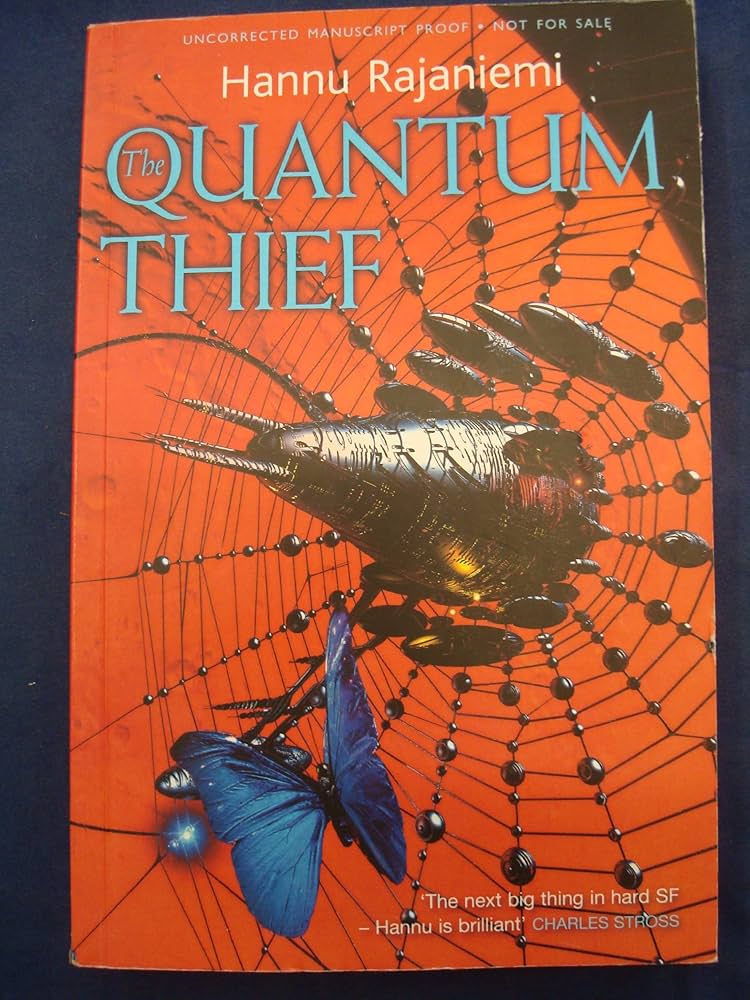
While I love a good sci-fi as much as the next person, this novel was a very difficult read – not because it’s hard sci-fi, but because the main character is so damn dislikeable.
The Game is described at the start of the book:
The Archons of the Dilemma Prison want you to feel it. It’s educational.
The Prison is all about education. And game theory: the mathematics of rational decision-making. When you are an immortal mind like the Archons, you have time to be obsessed with such things. And it is just like the Sobornost – the upload collective that rules the Inner Solar System – to put them in charge of their prisons.
We play the same game over and over again, in different forms.
An archetypal game beloved by economists and mathematicians. Sometimes it’s chicken: we are racers on an endless highway, driving at each other at high speeds, deciding whether or not to turn away at the last minute. Sometimes we are soldiers trapped in trench warfare, facing each other across no-man’s-land. And sometimes they go back to basics and make us prisoners – old-fashioned prisoners, questioned by hard-eyed men – who have to choose between betrayal and the code of silence. Guns are the flavour of today. I’m not looking forward to tomorrow.
His characters are post-human, yes they exist as software iterations of themselves, and yes they are far removed from us, but despite their change in form, they are still driven by desires and ambitions and fear and love and all the things that make us human. Including an erection.
Something stirs between my legs and banishes at least some of
my doubts.‘Sorry. It’s been a while,’ I say, studying my erection with
detached interest.‘Evidently,’ she says, frowning. There is an odd expression on
her face, a mixture of disgust and arousal: I realise she must be listening to
this body’s biot feed, a part of her feeling what I’m feeling.
And no character is more flawed than the novel’s protagonist, master thief Jean le Flambeur, broken out of a software prison by a female warrior named Mieli and set on a mission by a distant higher power to steal something of great value in the Oubilette, one of Mars’ moving cities. Le Flambeur has lived so many lives that he’s intentionally forgotten most of them, but reclaiming his Martian memories is one of the key points the novel hinges on.
‘I did something very stupid.’
‘I’d expect no less,’ Isaac says. ‘Want me to punish you? Want
God to punish you? I’ll gladly oblige. Come here so I can smack you.’
The sci-fi aspect is hard-core and I, like many other readers, liked gevulot, this idea of crypto-backed privacy where, even during ordinary conversations, people exchange contracts with each other to govern how the other party sees you and how much of the conversation they are allowed to remember, made possible since all memory is stored in the city-wide exomemory.
There’s some other things that make the book great.
Why the two stars then? I was reading it in bits and I always had to go back a few pages and retraced what I’d read just to make sure I understood the context of the page I was on. It was deeply brow-furrowing and had a few times I had to stop and google terms as I couldn’t for the life of me understand what they were talking about.
This Hunter will not be one, but many: able to split itself into
many parts and become one again. He gives it a single-mindedness he found in an Oortian sculptor, and the coordination ability of a concert pianist, seasoned with more primitive animal forms from the older libraries: shark and feline. He gives it enough cognitive rights to be intelligent, but not enough to have latency, and allocates a fragment of the guberniya smartmatter to it, so it is ready to be launched when its new mistress commands.The finished thing does not speak, but regards them both silently, observing, waiting for a target. It has the kind of beauty that weapons often have, the kind that lures you to touch it even though you know that its sharp edges will cut.
Apparently there are other books in this mix but I guess I’ll give them a pass.
 One Book a Week (Julia Reads Books)