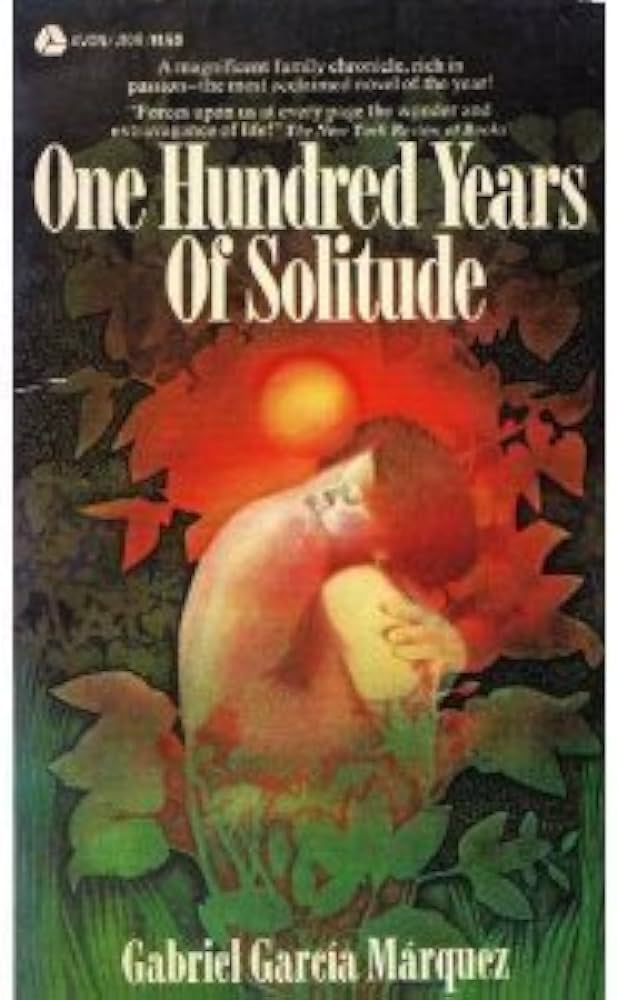
The brilliant, bestselling, landmark novel that tells the story of the Buendia family, and chronicles the irreconcilable conflict between the desire for solitude and the need for love—in rich, imaginative prose that has come to define an entire genre known as “magical realism.”
Marquez was one of the first writers to use “magical realism,” a style of fantasy wherein the fantastic and the unbelievable are treated as everyday occurrences. While I’m sure it contributed to the modern genre of urban fantasy – which also mixes the fantastic with the real – magical realism doesn’t really go out of its way to point out the weirdness and the bizarrity. These things just happen. A girl floats off into the sky, a man lives far longer than he should, and these things are mentioned in passing as though they were perfectly normal.
The other one is Murakami but we won’t talk about him today.
One Hundred Years of Solitude is a novel so strange, so rich, so perfect in its singularity and timeless in its tenor, one can scarcely believe it was written as recently as 1967. At its start we are treated to an inkling of the author’s narrative conjuring:
“Many years later, as he faced the firing squad, Colonel Aureliano Buendía was to remember that distant afternoon when his father took him to discover ice.”
Past, present, and future are entwined in what seems at first a simple opening sentence, and the book’s persistent themes of memory, prophecy, and wonder are introduced in a manner so intriguing that we barely stop to notice because we’re eager to discover what’s to come.
Gabriel García Márquez’s chronicle of the mythical town of Macondo, and of the bizarre, impossible, beautiful, and desolate history, through seven generations of the family of its founders, José Arcadio Buendía and his wife, úrsula Iguarán, is one of the marvels of modern literature.
It is peopled with extraordinary characters: from José Arcadio and úrsula’s descendants (a plethora of José Arcadios and Aurelianos among them) to the heart-stoppingly striking Remedios the Beauty, the dirt-eating Rebeca, Mauricio Babilonia, an ill-starred mechanic constantly accompanied by a swarm of yellow butterflies, and Melquíades, the gypsy who seems to orchestrate the Buendías’ passage through time.

Another element of dreaminess that pervades this book is that there’s really no story here, at least not in the way that we have come to expect. Reading this book is kind of like a really weird game of The Sims – it’s about a family that keeps getting bigger and bigger, and something happens to everybody.
So, the narrator moves around from one character to another, giving them their moment for a little while, and then it moves on to someone else, very smoothly and without much fanfare. There’s very little dialogue, so the story can shift very easily, and it often does.
Gaston was not only a fierce lover, with endless wisdom and imagination, but he was also, perhaps, the first man in the history of the species who had made an emergency landing and had come close to killing himself and his sweetheart simply to make love in a field of violets.
It is also filled with remarkable events: an insomnia plague that threatens the memory of the entire town, a five-year rainstorm that follows the massacre of three thousand striking banana workers by government troops, an unsuspected facility in Latin that springs to the lips of the patriarch when his senility leads to his being tethered to a tree in the yard for his sunset years.
The author’s vaunted magical realism imbues mundane events with a majesty commensurate with their emotional resonance, as in this description of the aftermath of the second José Arcadio’s mysterious death by gunshot:
A trickle of blood came out under the door, crossed the living room, went out into the street, continued on in a straight line across the uneven terraces, went down steps and climbed over curbs, passed along the Street of the Turks, turned a corner to the right and another to the left, made a right angle at the Buendía house, went in under the closed door, crossed through the parlor, hugging the walls so as not to stain the rugs, went on to the other living room, made a wide curve to avoid the dining-room table, went along the porch with the begonias, and passed without being seen under Amaranta’s chair as she gave an arithmetic lesson to Aureliano José, and went through the pantry and came out in the kitchen, where úrsula was getting ready to crack thirty-six eggs to make bread.
Economic, political, and historical forces—the colonialism represented by the banana company, the never-ending revolutionary campaigns of Colonel Aureliano Buendía and his insurgents, the arrival of the railroad—make incursions into Macondo, but they sweep through the life of the family like weather patterns, leaving devastation in their wake.
So although one can read the novel as a metaphorical history of Colombia, the author’s homeland, or as a more far-reaching fable of the forces of inexorable decay that fuel nature and overcome civilizations—and it is, decidedly, both—the more fundamental spirit of the book engages the perplexities of time and memory on a human scale.
“…time was not passing…it was turning in a circle…”

From that initial sentence, the author leads us into a different dimension, in which temporal reality is not a line, but a Möbius strip, turning in on itself in one continuous and endless loop.
“Wherever they might be they always remember that the past was a lie, that memory has no return, that every spring gone by could never be recovered, and that the wildest and most tenacious love was an ephemeral truth in the end.”
García Márquez once said he found the key to writing the book in the stories told him over and over again by his grandparents, and the character of such recountings indeed infuses the book with its peculiar atmosphere. The past and its personalities have been polished by use and repetition into legends, ennobled by the nostalgia and emotion of the teller, as if the pages themselves have evolved their own memory, and—to quote the manuscript of Melquíades decrypted in the book’s final pages—“concentrated a century of daily episodes in such a way that they coexisted in one instant,” or, let us say, in a single seductive, mesmerizing novel.
 One Book a Week (Julia Reads Books)