This is perhaps one of my favourite books and I’ve always set some time aside to re-read it on a yearly basis. I had a look through my years of posting and I realized I have never posted anything about it. So here it is. More than a review on feminism like – The desire to be a free woman in Jane Eyre. A good one.

What’s the book about? In very short sentences, it’s the story of a girl charting a course through adversity and uncertainty toward a life of agency and fulfillment.
“Reader, I married him.”
Destitute young woman leaves rotten boarding school for job as governess in sprawling mansion, falls in love with broodingly handsome employer with dark secret. In the twenty-first century, the plot of Jane Eyre might sound clichéd, yet Charlotte Brontë’s 1847 novel, about a plain orphan girl exceeding her lot in life through righteousness and strong will tempered by desire, was and remains a true original. Not only might it be said to have inspired the imaginative atmosphere of countless fictions, movies, and television shows created in its wake, in a very real way Jane Eyre made available to readers modes of feeling that had never been articulated quite so tellingly before. As only the most powerful stories can, it seems to invent through expression the emotional truths it explores.
”Women are supposed to be very calm generally: but women feel just as men feel; they need exercise for their faculties, and a field for their effort, as much as their brothers do; they suffer from too rigid a restraint, too absolute a stagnation, precisely as men would suffer, and it is narrow-minded in their more privileged fellow-creatures to say that they ought to confine themselves to making puddings and knitting stockings, to playing on the piano and embroidering bags. It is thoughtless to condemn them, or laugh at them, if they seek to do more or learn more than custom has pronounced necessary for their sex.”
If Jane Austen charts the course of the coming of age and the coming of love in a social context that both defines her characters and to varying degrees determines their fates, Charlotte Brontë portrays a private life that struggles to maintain its shape and substance despite the buffetings of circumstance and the oppressions of social station.
I care for myself. The more solitary, the more friendless, the more unsustained I am, the more I will respect myself.”
Jane Eyre tells one woman’s story in her own compelling voice—not for nothing was it originally subtitled “An Autobiography.” As she battles a stifling society and weathers storms of ardor and confusion, Jane must hold fast to the ideal of personal happiness in a world in which its denial is regarded not only as the norm, but as a moral imperative. Her narration of her passage from poor relation to self-possessed mistress of her destiny is, in its own way, as thrilling as any swashbuckling tale.
That the story of Jane, Rochester, and his mad wife in the attic has been adapted, updated, and interpreted a thousand times over speaks to the power of the tale and its timeless appeal. Yet, for all the imitation, the exquisite passion of this most romantic of novels has never quite been equaled.
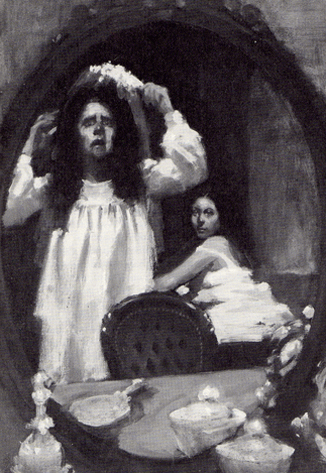
In Charlotte Brontë’s Jane Eyre, that’s how readers meet Bertha Mason, the first wife of Edward Rochester, the man Jane is about to marry. The revelation of her existence exposes Rochester’s duplicity, disrupting his bigamous wedding to Brontë’s heroine. The madwoman in the attic plays a larger role in the novel’s plot—but that’s another story.
What makes Rochester unique is that he does eventually see Jane the way she sees herself. ”Fair as a lily, and not only the pride of his life, but the desire of his eyes.” I will remember that line ”desire of his eyes” for a long time. She is a hidden gem in rooms full of people. Charlotte Bronte makes some good points through Jane’s eyes at how unaware wealthy people are of the true natures of those who serve them.
I have for the first time found what I can truly love–I have found you. You are my sympathy–my better self–my good angel–I am bound to you with a strong attachment. I think you good, gifted, lovely: a fervent, a solemn passion is conceived in my heart; it leans to you, draws you to my centre and spring of life, wrap my existence about you–and, kindling in pure, powerful flame, fuses you and me in one.
 One Book a Week (Julia Reads Books)