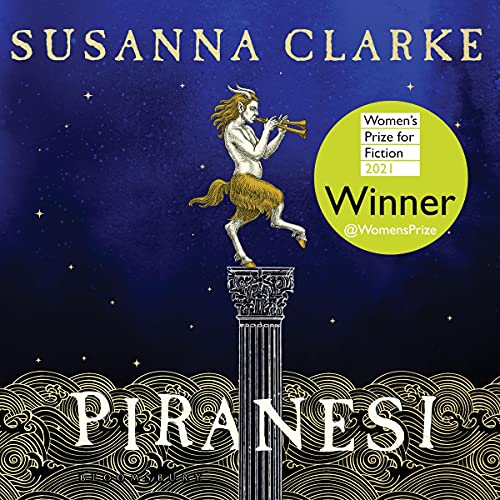
Winner of the 2021 Audie Awards Audiobook of the Year. Winner of the 2021 Women’s Prize for Fiction. Shortlisted for The Costa Novel of The Year Award. A Sunday Times and New York Times best seller.
Why Piranesi?
I once asked the Other why he called me Piranesi.
He laughed in a slightly embarrassed way. Oh, that (he said). Well, originally it was a sort of joke I suppose. I have to call you something. And it suits you. It’s a name associated with labyrinths. You don’t mind, do you? I’ll stop if you don’t like it.
The Plot
Piranesi lives in the House. Perhaps he always has.
In his notebooks, day after day, he makes a clear and careful record of its wonders: the labyrinth of halls, the thousands upon thousands of statues, the tides that thunder up staircases, the clouds that move in slow procession through the upper halls. On Tuesdays and Fridays Piranesi sees his friend, the Other. At other times he brings tributes of food to the Dead. But mostly, he is alone.
Messages begin to appear, scratched out in chalk on the pavements. There is someone new in the House. But who are they and what do they want? Are they a friend or do they bring destruction and madness as the Other claims?
Lost texts must be found, secrets must be uncovered. The world that Piranesi thought he knew is becoming strange and dangerous.
The beauty of the House is immeasurable; its kindness infinite.
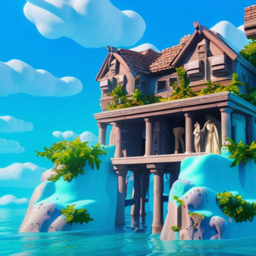
I tried a few AI image generators to emulate a house where there are a lot of statues in which the waves roll in but it doesn’t even cut it. The houses are all too small. There are 108 vestibules in the house that Piranesi looks after. There are indeed many levels and the ocean is huge. The birds are huge.
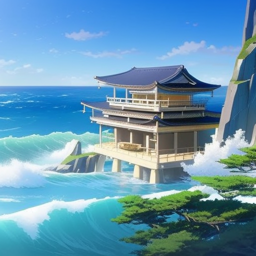
There isn’t even a generic image style of the house. What if it’s a pagoda? All I could sense was vastness and a labyrinth.
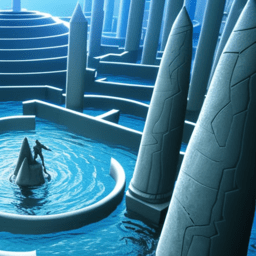
You see, the labyrinth plays tricks on the mind. It makes people forget things. If you’re not careful it can unpick your entire personality
I loved the idea of a place which gave you amnesia the more time you spent in it. Piranesi spent so much time in there he forgot his own name. He has an inkling of his general age and gender but he does not remember how he got there. He made up his life based on the traces of other skeletons he has found there. Because there is no other time than the present in the Labyrinth.
Nowhere is there any disjuncture where I ought to remember something but do not, where I ought to understand something but do not. The only part of my existence in which I experience any sense of fragmentation is in that last strange conversation with the Other. And so I have to ask Myself: whose memory is at fault? Mine or his? Might he in fact be remembering conversations that never happened?
Two memories. Two bright minds which remember past events differently. It is an awkward situation. There exists no third person to say which of us is correct. (If only the Sixteenth Person were here!)
Memory is tricky as it’s known to change based on time and experience. And when new light shines, sometimes, the truth gets distorted.
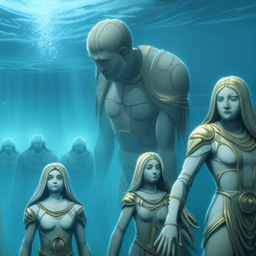
It’s only the submerged statues that give Piranesi a sense of calm and belonging. The Other is the only living person besides Piranesi who visits the house and sometimes brings gifts like vitamins and shoes – all things of the modern age. In a place like this – where just water and walls and statues reside, there are no factories, there are no workers, so there is an inkling that what we’re looking at is either a massive experiment where they want to see how humans manage in a place filled with “nothing” and “something” or an alternate world.
But it seemed to me that the wisdom of the ancients could not have simply vanished. Nothing simply vanishes. It’s not actually possible. I pictured it as a sort of energy flowing out of the world and I thought that this energy must be going somewhere. That was when I realised that there must be other places, other worlds. And so I set myself to find them.
‘And did you find any, sir?’ I asked.
‘I did. I found this one. This is what I call a Distributary World – it was created by ideas flowing out of another world. This world could not have existed unless that other world had existed first. Whether this world is still dependent on the continued existence of the first one, I don’t know. It’s all in the book I wrote. I don’t suppose you happen to have read it?’
It’s interesting that “The Other” wrote a book. He must be a scientist or a novelist I kept on thinking. But what is Piranesi? That is one mystery which will stay with us till the end of the book. He’s not the one who’s important – it’s this place which is center-piece and the search for knowledge and meaning.
Before I had seen this world, I thought that the knowledge that created it would somehow still be here, lying about, ready to be picked up and claimed. Of course, as soon as I got here, I realised how ridiculous that was. Imagine water flowing underground. It flows through the same cracks year after year and it wears away at the stone. Millennia later you have a cave system. But what you don’t have is the water that originally created it. That’s long gone. Seeped away into the earth. Same thing here.
You can say the same thing about knowledge. What if everyone disappeared from the face of the earth and no-one remained to explain what the great things we did were.
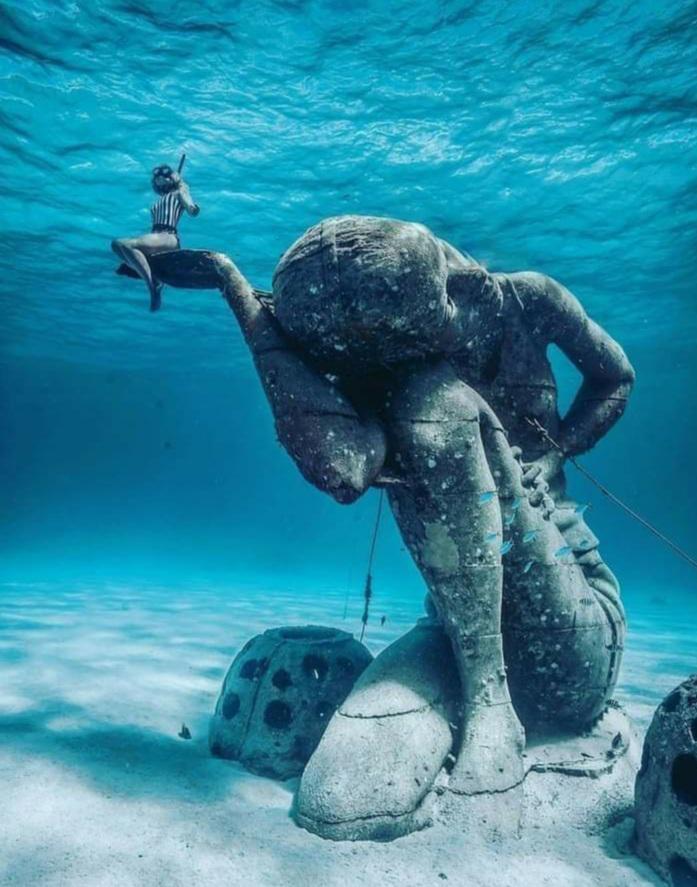
It seems that people can travel between this world and the submerged one doing incantations and focusing on a candle. The problem is that once you are there, your memory will start deteriorating and you either go mad living in there and die or you get lost in the labyrinths and die. Not many made it back. 15 died in there based on the skeletons Piranesi found. And we do find out who he is – he was a reporter investigating the disappearances until he got too close to the source and he went missing too.
It was as if the world had somehow just stopped. He fell silent. The Berlioz was cut off mid-chorus. My eyelids were still closed but I could tell that the quality of the darkness had changed; it was greyer, cooler. The air felt colder and much damper, as if we’d been plunged into a fog. I wondered if somewhere a door had been thrown open; but that made no sense because at the same time the hum of London ceased. There was a sound of vast emptiness, and all around me waves were hitting walls with a dull thud. I opened my eyes.
The walls of a vast room rose up around me. Statues of minotaurs loomed over me, darkening the space with their bulk, their massive horns jutting into the empty air, their animal expressions solemn, inscrutable.
I turned in utter incredulity.
I loved the reference to the minotaurs. And the multiple ways you can travel. Piranesi has mastered the labyrinth and could find his way out with ease. But it wouldn’t be a story if there wasn’t some sort of a monster in there too. Is it “The Other”? Is it Piranesi himself as he’s lacking the memory for it? Or is it a new one, a female, who has joined them of whom “The Other” is afraid of.
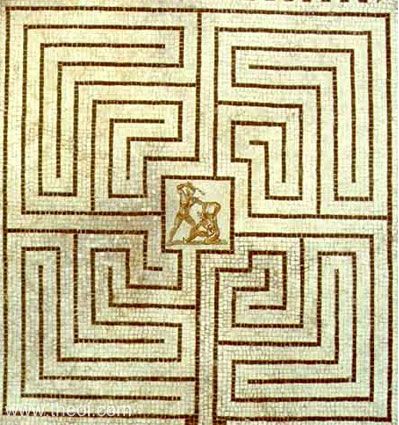
‘And the Other World has different things in it. Words such as “Manchester” and “police station” have no meaning here. Because those things do not exist. Words such as “river” and “mountain” do have meaning but only because those things are depicted in the Statues. I suppose that these things must exist in the Older World. In this World the Statues depict things that exist in the Older World.’
‘Yes,’ said Raphael. ‘Here you can only see a representation of a river or a mountain, but in our world – the other world – you can see the actual river and the actual mountain.’
This annoyed me. ‘I do not see why you say I can only see a representation in this World,’ I said with some sharpness. ‘The word “only” suggests a relationship of inferiority. You make it sound as if the Statue was somehow inferior to the thing itself. I do not see that that is the case at all. I would argue that the Statue is superior to the thing itself, the Statue being perfect, eternal and not subject to decay.’
I freaking loved the book.
I think it’s fairly obvious. It’s almost like The Raw Shark Texts by Steven Hall and House of Leaves * Mark Z. Danielewski * story of the labyrinth but it sits in its own range. It’s a discussion about art and the watcher, about being lost, about being found and what it means to be truly alone and isolated. It’s not a sad book. It’s filled with wonderment which can only easily appear through the eyes of a child. The statues are not just blocks of stone, they are meaning.
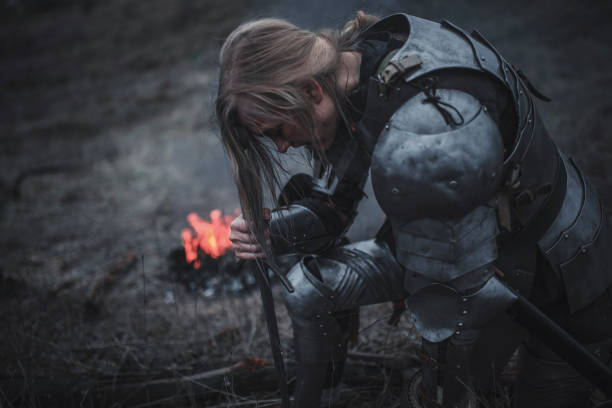
I think of Dr Ketterley and an image rises up in my mind. It is the memory of a statue that stands in the nineteenth north-western hall. It is the statue of a man kneeling on his plinth; a sword lies at his side, its blade broken in five pieces. Roundabout lie other broken pieces, the remains of a sphere. The man has used his sword to shatter the sphere because he wanted to understand it, but now he finds that he has destroyed both sphere and sword. This puzzles him, but at the same time part of him refuses to accept that the sphere is broken and worthless. He has picked up some of the fragments and stares at them intently in the hope that they will eventually bring him new knowledge.
And

I think of Laurence Arne-Sayles and an image rises up in my mind. It is the memory of a statue that stands in an upper vestibule, facing the head of a staircase (the one rising up out of the thirty-second vestibule). This statue represents a heretical pope seated on a throne. He is fat and bloated. He lolls on his throne, a shapeless mass. The throne is magnificent, but the sheer bulk of the figure threatens to split it in two. He knows that he is repulsive, but you can see by his face that the idea pleases him. He revels in the thought that he is somehow shocking. In his face there is mingled laughter and triumph. Look at me, he seems to say. Look at me!
I think in the end the book managed really well to convey its meaning. We’re all in a house of sorts. We all look at art or works created by others before us. It’s up to us whether we crawl into the stairway space and cry and ask for help or whether we get up and face the labyrinth of decisions. Some might take us to drowned worlds, some might lead us to new friends. Some might reveal foes. But all around us there is wonder.
I came out of the park. The city streets rose up around me. There was a hotel with a courtyard with metal tables and chairs for people to sit in more clement weather. Today they were snow-strewn and forlorn. A lattice of wire was strung across the courtyard. Paper lanterns were hanging from the wires, spheres of vivid orange that blew and trembled in the snow and the thin wind; the sea-grey clouds raced across the sky and the orange lanterns shivered against them.
The Beauty of the House is immeasurable; its Kindness infinite.
 One Book a Week (Julia Reads Books)