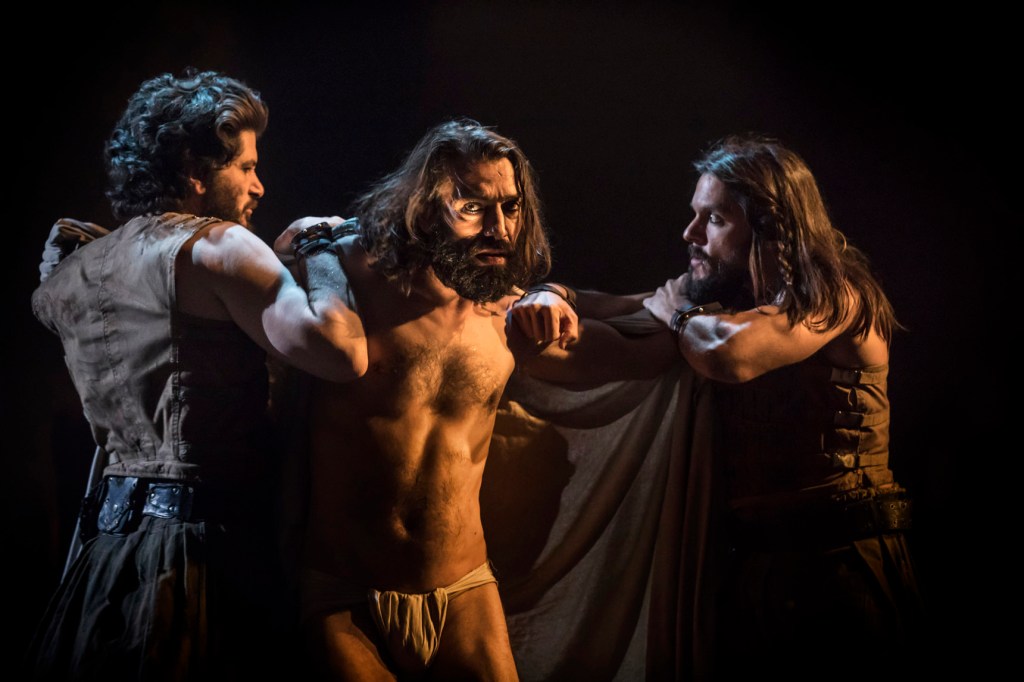
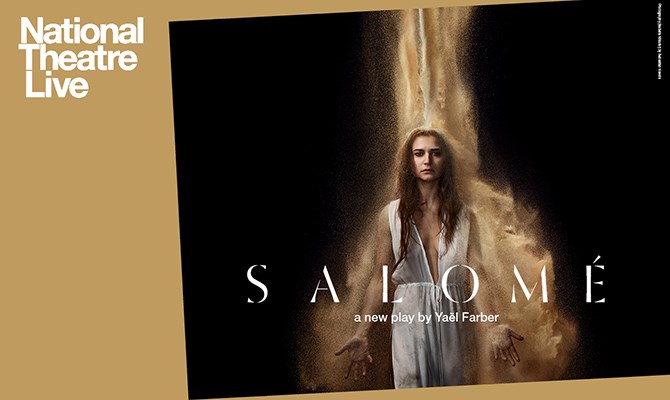
Yaël Farber has made this great show and I was lucky enough to watch it on demand the other day. And it got me thinking – this story has been told so many times over the years and who exactly is Salome?

The Salome of history may have been a teenage girl of small stature, but as a figure of culture and mythology she is a giant. Elements of the story have resonance as far back as Caligula’s orgiastic court, yet in many ways the last one hundred years have seen the myth exercise its most powerful fascination. Salome has become the archetypal femme fatale, a figure of desire and doom, embracing her own destruction even as she lures men to their deaths. In modernity, references to the erotic dancer range from Oscar Wilde’s end-of-last-century play, Salome, all the way through to Kim Wilde’s end-of-century song. The House of Salome – that is, from the sublime all the way to the ridiculous.
Ironically enough, Salome’s name is probably better known now than it was by her contemporaries, or even succeeding generations. While her story first appears in the Bible, as a character she is almost a cipher, her name not even rating a mention. In the biblical allegory she is very much her mother’s tool of vengeance, dancing for Herod and claiming as her reward the head of John the Baptist on the instruction of Herodias, whom John had condemned as an incestuous adulterer. Herod himself exhibits a kind of bond with John, whom he is loathe to execute for fear of reprisal from his followers and his God. In this way Johns strength of character is figured in opposition to Herod’s spiritual and moral weakness. and the mystical ascetic John is portrayed as the precursor of the coming Jesus.
Medieval representations of Salome were often made for the purpose of moral instruction. In the religious art and practices of the Middle Ages, the Biblical legend found echoes too numerous to mention in detail.
As the reputation of John the Baptist grew in the centuries after the death of Christ, so did the myth of Salome’s evil.
The story was used to illustrate the need to resist sexual temptations and the potential spiritual risks in the diversion of dancing. After 1000 AD, the story was represented on church walls, in stained glass, and on the pages of sacred manuscripts. Certain monastic sects, taking as their inspiration the ascetic figure of the John the Baptist, developed a culture that was anti-feminine in the extreme. Their artistic depictions of the legend show Herodias and Salome as witches on brooms, or medusas with snake-like hair, able to turn a man to stone by simply engaging his gaze.
In the Victorian era, a pre-modern flourishing of references laid the groundwork for our contemporary fascination with the myth. One researcher uncovered more than 2.500 French poets who had written on Salome.

In the late nineteenth century, and throughout the twentieth century, the myth has been refigured pointing to a peculiar fascination with the way sex and power intersect in the drama. Yael’s version is important in making Salome a creature with desires of her own She is elevated to more than merely her mother’s pawn, becoming the autonomous agent of Johns death From the nameless dancer in the Bible story she has become the focus of the drama, whose actions symbolise the sexual power of modern woman.

Christian tradition has come to provide a rich source of raw material for secular artistic approaches to the subject of sexuality and desire.
For dealing with Biblical material, and for its dangerously subversive view of sexual passion, the original Oscar Wilde play was banned in England, but premiered in Paris in 1894. The Freudian paradox of the struggle between the pleasure principle and the drive towards death is fought out. Herod loses control of his desire, and potentially the wealth of his kingdom, caught up in the voyeuristic pleasure of holding his stepdaughter in his lustful gaze. Salome, her sexual advances rejected by the almost super-human saint, uses Herod as a tool to have John on her own terms, his decapitation a symbolic castration at the hands of the wanton female.
The innocent, her lusts awakened by the unlikely figure of John, the mad, pale, emaciated prophet, pursues her unfulfilled desire to its logical conclusion, her own bloody end. Life mirrors art, and Salome was a personal work, not just a dramatic one. for Wilde As he wrote in The Ballad of Reading Gaol, in another phrase that has peculiar resonance in this century of perversity, “Yet each man kills the thing he loves.”
In 1953 Hollywood tried again, without success, to popularise the Salome myth with Rita Hayworth in the lead role, and Charles Laughton as Herod. While set in authentic Holy Land exteriors, the story was heavily laundered for the American censors and public – Salome danced, not for the head of John the Baptist on a platter, but to save him from execution.


The emergence of the figure of Salome, from nameless dancer in the Bible story through to the focus of modern versions of the story, can be seen as parallel with the empowerment of women in the political sphere, as representative of increasing acknowledgement of what Freud called the “Dark Continent” of female sexuality, or linked with the increasing public tolerance of sexual desires previously thought perverse.
Yael makes a move too. Instead of the femme fatale who danced naked, she becomes a symbol of persecuted womanhood who acquires political agency.
Throughout the long history of the myth, though, it is Salome’s dance more than any political reading of it that is the focal point around which our fascinations spin. Dance, all dances, is the pleasure of listening embodied. Nowhere will this be more apparent than in Sydney Dance Company’s current production, latest in a long line of myth making about Salome. Perhaps it is only in dance that a myth so concerned with the power of dance can be fully realised. A saucy striptease, a revelation in movement of our own hidden desires and sexualities, and a transcendent moment that embodies what it means to be human, dance itself is the essence of the tale of Salome.
 One Book a Week (Julia Reads Books)