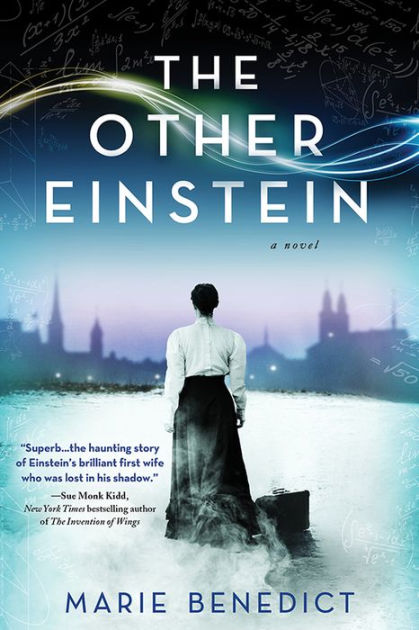
Mitza Maric has always been a little different from other girls. Most twenty-year-olds are wives by now, not studying physics at an elite Zurich university with only male students trying to outdo her clever calculations. But Mitza is smart enough to know that, for her, math is an easier path than marriage. And then fellow student Albert Einstein takes an interest in her, and the world turns sideways. Theirs becomes a partnership of the mind and of the heart, but there might not be room for more than one genius in a marriage.
While this book needed to be written just to draw attention to Einstein’s brilliant other half, I’m not sure it ended up written well. I was bored. So bored. Read through it, flipping one page after another, waiting for a little bit of saucy sauce. A bit of intrigue.
All I got was “woe is me, I am a woman with a limp in a man’s world and they shall respect my intelligence”. I agree with the concept. I’m a woman in STEM and it’s hard. It was hard for the early birds too. You have to work twice as hard for half the recognition.
Do you remember the first time you realized that you were different from other girls? Smarter perhaps?
Benedict’s novel carries a story line that isn’t consistent with historical research (Her author’s note is built on ideas like “maybe,” “perhaps,” and “we don’t know.”) Were the allegations true, it would be a whopper. A much more interesting book would have been to follow the true story of Mileva’s life — a brilliant scientist in her own right (the only female studying at the Zurich Polytechnic at the time Einstein was getting his degree) who had to give up her scientific ambitions when she became a mother. Einstein comes off extremely badly and I was shocked by the scene in which he hits her , which I think was just gratuitous and doesn’t seem to be based on any historical facts. I feel like people will read this and think it’s a factual expose, whereas it’s mostly wild speculation and likely to be highly inaccurate.
Mitza, you are like the objects in one of Newton’s investigations. You tirelessly maintain your velocity through life unless you are acted upon by an outside force. I hope no outside force ever changes your velocity.
The writing was inelegant and clunky throughout. Some of the sentences were badly constructed and I also thought the dialogue was self-consciously formal and ‘old fashioned’. There were also some jarring errors which would make anyone vaguely scientifically minded wince, eg, steam (from the chimney of a steam train) being described interchangeably as ‘smoke’ and ‘fog’ in the same paragraph.
“I had awoken my strength. I would not endure humiliation at Albert’s hands again, whether personal or professional. If Albert didn’t appreciate the meek helpmate I had become in our latter years together—the failed physicist from whom he could pilfer ideas at will and the wife bendable at his beckoning—he positively loathed the return of the old Mileva in Berlin. And that was precisely who would greet him at the door when he returned from his cowardly flight to his lover, Elsa. The very thought of Elsa—all perfumed and dyed blond hair, exactly the sort of idle, pampered, bourgeois woman about which Albert used to complain—sickened me. Less because she had “stolen” Albert from me and more because of her perfidy. “Please, Mrs. Einstein, allow me to help you,” Elsa had said with an obsequious smile when the boys and I went to Berlin alone in the days after Christmas to find an apartment. Albert had sent her over to the hotel to “assist” us without my foreknowledge. Staring at the ruby-red smile painted upon her lips, I couldn’t speak. Her audacity coming here, seeking out the woman she’d betrayed, silenced me. Elsa, as she insisted we call her, continued regardless.”
Terrible read. Went to the Charity pile.
 One Book a Week (Julia Reads Books)