The Drowned World is a 1962 science fiction novel by British writer J. G. Ballard. The novel depicts a post-apocalyptic future in which global warming caused by heightened solar radiation has rendered much of the Earth’s surface uninhabitable. The story follows a team of scientists researching environmental developments in a flooded, abandoned London.
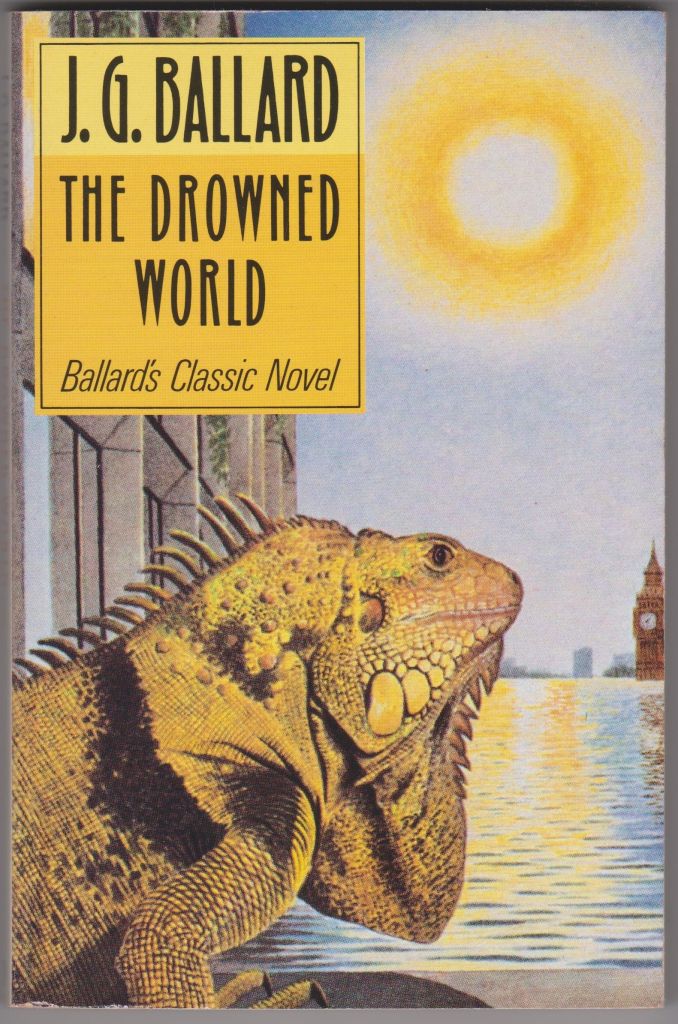
In the late 21st Century, sudden violent and prolonged solar storms enlarge the Van Allen belts, leading to a deterioration of the Earth’s ionosphere. Solar radiation bombards the planet, increasing temperatures, raising sea levels and imposing a tropical climate worldwide.
The succession of gigantic geophysical upheavals which had transformed the Earth’s climate had made their first impact some sixty or seventy years earlier. A series of violent and prolonged solar storms lasting several years caused by a sudden instability in the Sun had enlarged the Van Allen belts and diminished the Earth’s gravitational hold upon the outer layers of the ionosphere. As these vanished into space, depleting the Earth’s barrier against the full impact of solar radiation, temperatures began to climb steadily, the heated atmosphere expanding outwards into the ionosphere where the cycle was completed.
With most of the planet no longer habitable for humans, the survivors migrate to the newly-hospitable poles.
Apparently the water level is still rising, all the work we’ve done has been a total waste-as I’ve always maintained, incidentally. The American and Russian units are being recalled as well. Temperatures at the Equator are up to one hundred and eighty degrees now, going up steadily, and the rain belts are continuous as high as the 20th parallel. There’s more silt too-
I absolutely loved the way the author took time to consider how the melting ice caps will influence the look of current continents.
Driving the submerged silt before them, the new seas completely altered the shape and contours of the continents. The Mediterranean contracted into a system of inland lakes, the British Isles was linked again with northern France. The Middle West of the United States, filled by the Mississippi as it drained the Rocky Mountains, became an enormous gulf opening into the Hudson Bay, while the Caribbean Sea was transformed into a desert of silt and salt flats. Europe became a system of giant lagoons, centered on the principal low-lying cities, inundated by the silt carried southwards by the expanding rivers.
Years later, we first encounter Kerans. In a world where mammalian fertility has declined allowing reptiles and amphibian life forms to thrive, he’s a rare child – as “only one marriage in ten yielded any offspring”. There are less than 5 mil people remaining on this watery earth.
In 2145, Dr Robert Kerans is part of a scientific survey unit under the leadership of Colonel Riggs sent to catalogue the flora and fauna of a lagoon located within what was once the city of London. The members of the expedition begin to experience strange dreams. Amidst talk of the army and scientific team moving north, Lieutenant Hardman, the only other commissioned member of the unit, flees the lagoon and instead heads south; a search team is unable to prevent his escape.
As the other inhabitants of the lagoon finally flee the searing sun and head north, Kerans and two associates, the reclusive Beatrice Dahl and fellow scientist Dr Alan Bodkin, opt to remain. A team of pirates, led by an individual named Strangman, arrives to loot treasures within the deep. He seems oddly interested in Beatrice.
Strangman treated her with a strange deference, not unmarked by a polite hostility, almost as if she were a tribal totem, a deity whose power was responsible for their continued good fortune but nonetheless resented.
There’s also a wee bit of racism still present in this book as the only black guy is stereotyped as a singing clown.
Clearing his throat, with much prancing and gesticulation, the big negro began, his voice deep and guttural.
Mistah Bones, he loves dried men,
Got himself a banana girl; three prophets sly,
She played him all crazy, drowned him in the snake wine,
Never heard so many swamp birds,
That old boss alligator.Rum Bones, he went skull fishing,
Down off Angel Creek, where the dried men run,
Took out his turtle stone, waited for the chapel boat,
Three prophets landing,
Some bad joss.Rum Bones, he saw the loving girl,
Gave his turtle stone for two bananas,
He had that banana girl like a hot mangrove;
Prophets saw him,
No dried men coming for Rum Bones.Rum Bones, he danced for that loving girl,
Built a banana house for her loving bed-“
When Strangman and his team drain the lagoon and expose the city beneath, both Kerans and Bodkin are disgusted; the latter attempts to blow up the flood defences and re-flood the area, but without success. With Kerans and Beatrice resigned to their fate, Strangman pursues Bodkin and kills him in revenge.
Strangman and his team grow suspicious of Kerans. He and Beatrice are imprisoned, while Kerans is then tortured. He survives, although severely weakened by the ordeal, and attempts to save Beatrice from her imprisonment, to little avail. With Kerans and Beatrice facing the guns of Strangman and his men, the army under Colonel Riggs returns to save them at the last moment. The authorities co-operate with Strangman rather than punish him and Kerans once more grows frustrated by the inaction, finally taking a stand and succeeding in re-flooding the lagoon where Bodkin had failed.
Wounded and weak, Kerans flees the lagoon and heads south without aim, meeting the frail and blind figure of Hardman along the way. After he aids Hardman back to some amount of strength, he soon continues onwards on his travels south, “a second Adam searching for the forgotten paradises of the reborn sun”.
 One Book a Week (Julia Reads Books)
Leave a comment