Looking down at Earth from an orbiting spacecraft, a rational person could certainly feel that “necessary defence” may have more to do with the vulnerability of our beautiful blue planet, exposed to all the vicissitudes of the cosmos, than with the transient power of a single country’s weapons, policymakers, nationalists, and ideologues, however virulent. From hundreds of kilometers above the surface of the globe, “Peace on Earth, Goodwill Toward Men” might sound less like a standard line on a Christmas card and more like an essential step toward a viable future, in which all of humankind cooperates in protecting Earth from the enemies among us and the threats above us.
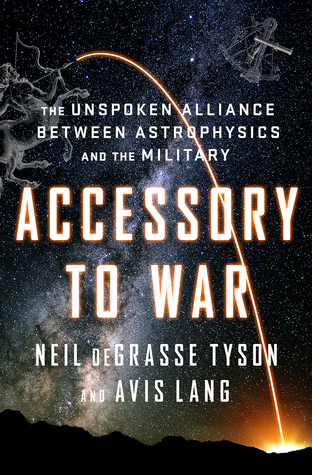
In this far-reaching foray into the millennia-long relationship between science and military power, acclaimed astrophysicist Neil deGrasse Tyson and co-author Avis Lang examine how the methods and tools of astrophysics have been enlisted in the service of war. Spanning early celestial navigation to satellite-enabled warfare, Accessory to War is a richly researched and provocative examination of the intersection of science, technology, industry, and power that will introduce Tyson’s millions of fans to yet another dimension of how the universe has shaped our lives and our world.
On the plane of raw human survival, scientists have cited overuse of antibiotics and the resultant increase in highly resistant microbes as a threat to national and ultimately global security, while the Pentagon, along with the United Nations and scientists across the globe, has identified climate change as a parallel threat—a trigger for regional conflicts over freshwater, food, and refugees; a condition leading to drought, wildfires, and pandemics; and a cause of rising sea levels, which in turn would redraw coastlines and submerge low-lying countries. The European Union contends that in the current era of “multifaceted, interrelated and transnational threats . . . the internal and external aspects of security are inextricably linked.
Economic constraints decide on the research priorities. And the entire annual budget for astrophysics is enough to cover the defence budget for a few days in most states. Given a choice, many researchers will opt for a pact with the military. Better to research with martial focus, than not at all. And the technologies, machines and research priorities are identical to some extent. From there onwards, either telescopes or missile launchers will be installed.

Research can and will always be adapted for military purposes. This could sometimes lead to work on military applications instead of basic research. That despite the availability of the technologies, these are primarily used for threatening gestures in the solar system rather than actively exploring space. Like the backlog of the peaceful use of many technologies on earth. Military secrecy and monopolies will keep insights and new devices under lock and key for a long time.
In the longer term, such as millennia or tens of thousands of years, man-made weapons will become less of an issue. Instead, the technical possibilities to directly manipulate space physics become the ultimate weapons of mass destruction. One could distract asteroids and meteors and manipulate magnetic fields and gravity. Open gates to the hearts of the suns and let the resulting beam move over planets as a sterilization laser. Build a black hole bomb in millions of years.
Besides making discoveries, astrophysicists have speculated that aliens might use lasers to broadcast obviously purposeful signals of their existence that would be picked up by skywatchers carefully monitoring known and suspected exoplanets. Some of us also speculate that aliens may power their interstellar probes with continuous beams from gigantic star-powered radio transmitters, which might explain the brief, otherwise unexplained flashes of radio waves that have been picked up by Earth’s largest radio telescopes and that appear to come from billions of light-years away
All in all, a pretty boring read with 200+ pages of notes and footnotes in a 675 page book. that’s a third. I don’t think I’ll read it again. I’m sure just this book has been written many times by many people. Reading this you’ll learn a lot about how sailors navigated by the stars over the centuries, about endless weapons systems and their capabilities, and of the many international agreements to limit nuclear weapons. As Tyson himself says elsewhere science is science. GPS can be used to navigate a tank around the desert or your car around a city. The engineers that developed this technology can’t be blamed for how it is used. That is for all of us and national policy makers to decide. Soldiers eat, are farmers therefore accessories to war?
 One Book a Week (Julia Reads Books)
Leave a comment