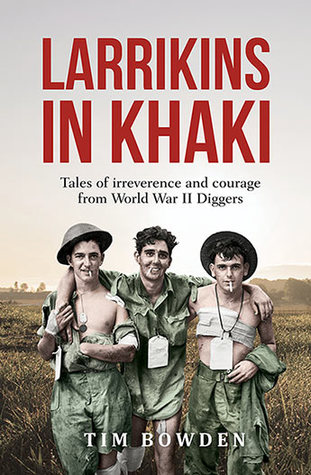
From recruitment and training and the battlegrounds of Palestine, North Africa, Thailand, Burma and beyond, here are the highly individual stories of Australia’s World War II Diggers told in their own voices – warts and all.
With a reputation for being hard to discipline, generosity to their comrades, frankness and sticking it up any sign of pomposity, Australian soldiers were a wild and irreverent lot, even in the worst of circumstances during World War II.
In Larrikins in Khaki, Tim Bowden has collected compelling and vivid stories of individual soldiers whose memoirs were mostly self-published and who told of their experiences with scant regard for literary pretensions and military niceties. Most of these men had little tolerance for military order and discipline, and NCOs and officers who were hopeless at their jobs were made aware of it. They laughed their way through the worst of it by taking the mickey out of one another and their superiors.
From recruitment and training to the battlegrounds of Palestine, North Africa, Thailand, New Guinea, Borneo and beyond, here are the highly individual stories of Australia’s World War II Diggers told in their own voices – warts and all.
As the weeks dragged by, morale slipped a bit, especially when signs of acute malnutrition started to show. One particular form of this was scrotal dermatitis, which was very painful indeed. It was usually referred to by the troops as ‘Bandoeng Balls’. Another form of malnutrition from which many suffered was a terrible burning sensation affecting the feet. Although it was commonly known as ‘Happy Feet’, it was anything but that.
I had thought it would just be a description of the Australian Soldiers bad behaviour but actually covered the experiences in the various campaigns throughout the war. Despite being well read on WW2 I learnt a lot
The reason why most men died is simple—they starved. The greatest atrocity committed by the Japanese against the prisoners was that they did not feed them. The Australian army ration of 1941 had given the men a daily intake of 4220 calories each—they could survive and do some work on 3000. In Changi they were getting just over 2000 calories and at that level they had been losing weight and suffering from deficiency diseases. In the railway camps, the few grams of rice, watery vegetable stew and infrequent flavouring instead of meat and fish was often giving them less nourishment than they got in Changi. This diet could not sustain men who were being forced to work at maximum effort. They were vulnerable to diseases that would not have killed, and perhaps not have afflicted, the prisoners had they been better fed.
Between the descriptions of diarrhoea, diphtheria, and other diseases which went and killed a lot of POWs, the author has some fun moments to talk about – as much fun as you would get in a prisoner situation. About an elephant spraying his own piss on the Japanese guards after they threw rocks at him when he was having a go. About latrines and how one of his mates fell in it. About keeping the food rations safe by dipping their “doodle” in it before having to go to the toilet (I would assume it’s not a finger).
The lad-culture and bro-mances are strong.
Dick Turpin and his gang of highwaymen bailed up a stagecoach. Dick called out, ‘Right gang let’s go. Rob the women and rape the men.’
One of his gang piped up, ‘You mean, rob the men and rape the women, don’t you Dick?’
A pansy stuck his head out of the coach window and called out, ‘Who’s robbing this coach, you or Mr Turpin?’
Two hundred Australians leapt to their feet and shouted, ‘That wasn’t Dick Turpin ya Pommie mug, that was Ned Kelly.’
Uproar!
Let’s just say I don’t think 1940’s were a very politically correct time.
Disease had a far greater impact on all combatants in the Beachhead Battles than any planners could have foreseen. Malaria was the greatest threat, but scrub typhus, ulcers and dysentery were almost universal. By January, for every one battle casualty, 4.8 casualties were admitted to forward area hospitals.
Again with the disease. And then a few battle descriptions and who did what. Towards the end of the book, it felt a bit repetitive but hey, that’s war.
 One Book a Week (Julia Reads Books)
Leave a comment