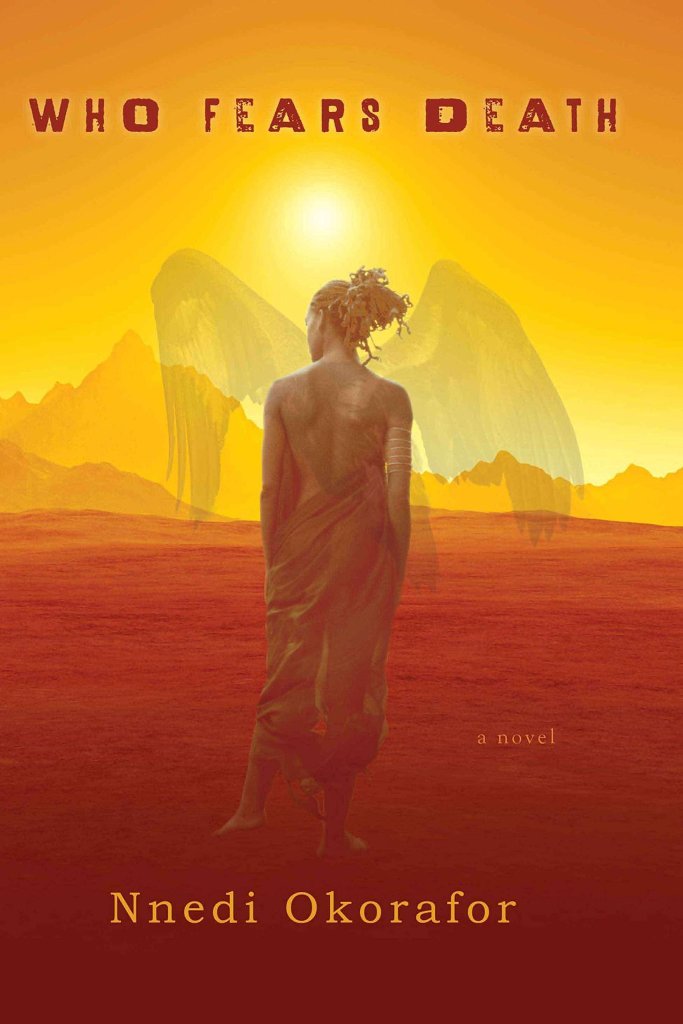
In a post-apocalyptic Africa, the world has changed in many ways; yet in one region genocide between tribes still bloodies the land. A woman who has survived the annihilation of her village and a terrible rape by an enemy general wanders into the desert, hoping to die. Instead, she gives birth to an angry baby girl with hair and skin the color of sand. Gripped by the certainty that her daughter is different–special–she names her Onyesonwu, which means Who fears death? in an ancient language.
It doesn’t take long for Onye to understand that she is physically and socially marked by the circumstances of her conception. She is Ewu–a child of rape who is expected to live a life of violence, a half-breed rejected by her community. But Onye is not the average Ewu. Even as a child, she manifests the beginnings of a remarkable and unique magic. As she grows, so do her abilities, and during an inadvertent visit to the spirit realm, she learns something terrifying: someone powerful is trying to kill her.
Desperate to elude her would-be murderer and to understand her own nature, she embarks on a journey in which she grapples with nature, tradition, history, true love, and the spiritual mysteries of her culture, and ultimately learns why she was given the name she bears: Who Fears Death.
My mother named me Onyesonwu. It means “Who fears death?” She named me well. I was born twenty years ago, during troubled times. Ironically I grew up far from all the killing …
Stories that come from a culture I’m not a part of teach me in their very telling, more about it, even when it’s a fantasy like this is. You can learn a lot about people by their art, and this is no exception.
The Okeke people have skin the color of the night because they were created before the day. Later, after much had happened, the Nuru arrived. They came from the stars and that’s why their skin is the color of the sun.
This wonderfully drawn out world is so full of contrasts. Beauty and ugliness, both in full bloom, often at the same time and in the same person. Okorafor understands the complexities of being not just human, but a human destined to change everything, and the hardships of those that follow behind.
The world she’s created is rich, diverse and completely different from the average fantasy novel. It does cover some challenging themes (rape, child sexual abuse, female genital mutilation) but these are in keeping with the culture in which she’s set her world.
I was trouble from the moment I was conceived. I was a black stain. A poison. I realized this when I was eleven years old. When something strange happened to me. The incident forced my mother to finally tell me my own ugly story.
The story of how she was an Ewu, a child of pain, born of a mother raped by a man of a different tribe in an attempt to break her marriage and her village (and it did). Her mother barely survived the rape and then was an outcast as the child was born with a visible marker of her origin (a sandy -coloured skin which told of the unnatural way she was conceived). During her 11th year, after her mother settles with Papa (a blacksmith), she has to undergo an ancient rite.
So us girls knew that a piece of flesh was cut from between our legs and that circumcision didn’t literally change who we were or make us better people. But we didn’t know what that piece of flesh did. And because it was an old practice, no one really remembered why it was done. So the tradition was accepted, anticipated, and performed.
So even though she’s 11, she doesn’t want to be circumcised and have a piece of her missing. All without anaesthetics. But here’s the old clinch: honour. Honour thy family and do old rituals which should have been (and had been in other regions) banned.
In Jwahir, to be uncircumcised past eleven brought bad luck and shame to your family. No one cared if you weren’t born in Jwahir. You, the girl growing up in Jwahir, were expected to have it done.
I brought dishonor to my mother by existing. I brought scandal to Papa by entering his life. Where before he had been a respected and eligible widower, now people laughingly said he was bewitched by an Okeke woman from the bloody West, a woman who’d been used by a Nuru man. My parents carried enough shame.
The mutilation ceremony is described in great detail as four girls go through the process. One who was sexually abused by her father, one who has intercourse with nameless boys and another who had a boyfriend. Only Onyesonwu was untouched at 11. The screams, the blood and the tradition make this horrendous practice take on a ceremonial role – of passing to adulthood while still a child.
We were also each given a stone to place underneath our tongues. This was called talembe etanou. My mother approved of this tradition, though its purpose had also long been forgotten. Hers was a very small, smooth orange stone. The stones vary with each Okeke group. Our stones were diamonds, a stone I’d never heard of. They looked like smooth ovals of ice. I held mine easily under my tongue. One was only to take it out when eating or sleeping. And one had to be careful at first not to swallow it. To do so was bad luck. Briefly I wondered how my mother hadn’t swallowed hers when I was conceived.
The book then slowly mixes in the supernatural, the other-wordly – the shape shifting and the tribal knowledge.
Even as a child, she manifests the beginnings of a remarkable and unique magic. As she grows, so do her abilities, and during an inadvertent visit to the spirit realm, she learns something terrifying: someone powerful is trying to kill her.
Desperate to elude her would-be murderer and to understand her own nature, she embarks on a journey in which she grapples with nature, tradition, history, true love, and the spiritual mysteries of her culture, and ultimately learns why she was given the name she bears: Who Fears Death.
‘The book is an untraditional fantasy novel; it actually features Black people in an alternate reality that is set in the Motherland. It also skews more toward the Octavia Butler end of the fantastical spectrum with believable, nuanced characters of color and an unbiased view of an Africa full of technology, mysticism, culture clashes and true love.’
Ebony Magazine (Editor’s Pick)
About the Author
Nnedi Okorafor was born in the United States to two Igbo (Nigerian) immigrant parents. She holds a PhD in English and is a professor of creative writing at Chicago State University. She has been the winner of many awards for her short stories and young adult books, and won a World Fantasy Award for Who Fears Death. Nnedi’s books are inspired by her Nigerian heritage and her many trips to Africa. She lives in Chicago with her daughter Anyaugo and family. She can be contacted via her website, http://www.nnedi.com, or on Twitter at twitter.com/nnedi.
 One Book a Week (Julia Reads Books)
Leave a comment