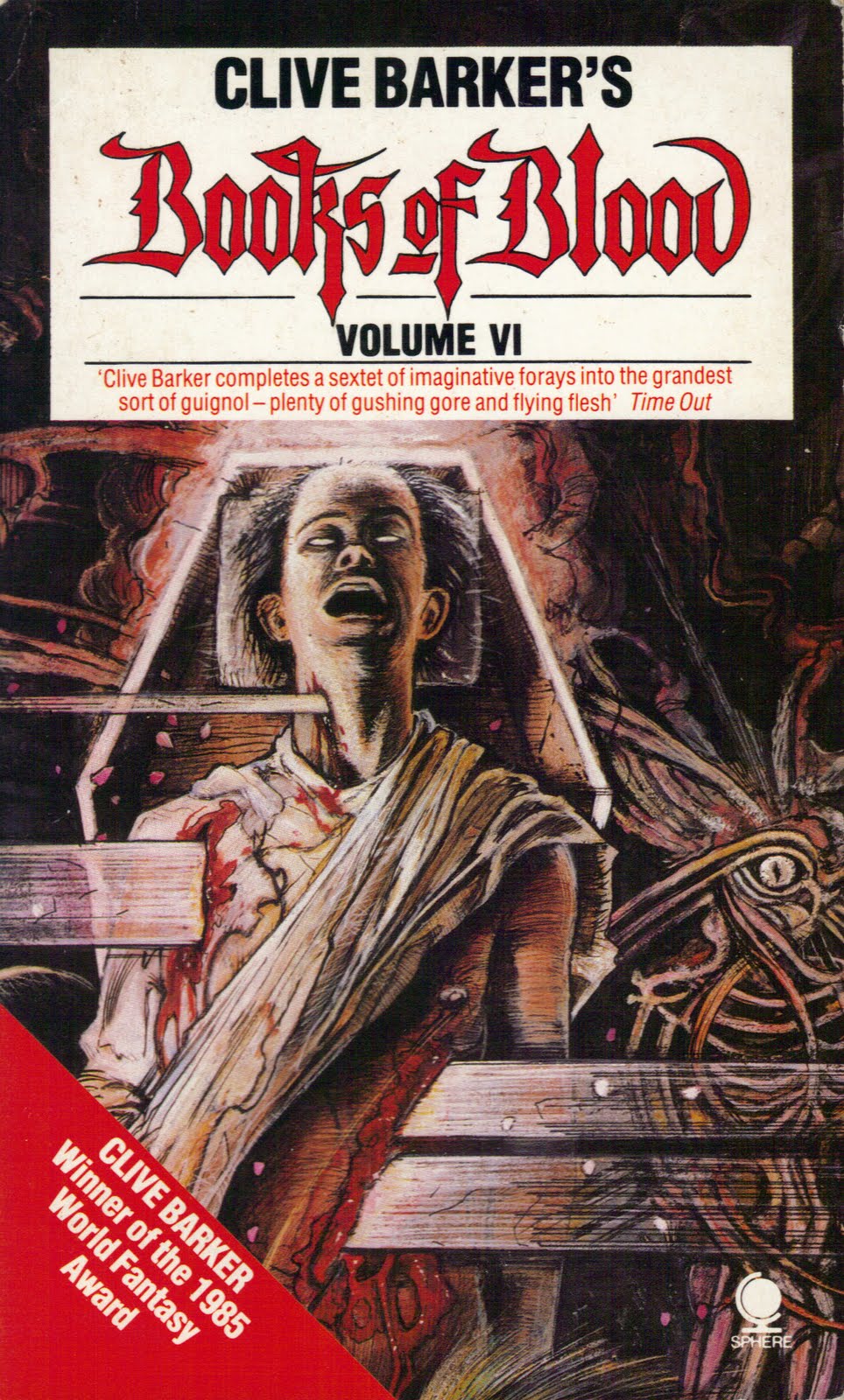
The Books of Blood combine the ordinary with the extraordinary while radiating the eroticism that has become Barker’s signature. Weaving tales of the everyday world transformed into an unrecognizable place, where reason no longer exists and logic ceases to explain the workings of the universe, Clive Barker provides the stuff of nightmares in packages too tantalizing to resist.
Never one to shy away from the unimaginable or the unspeakable, Clive Barker breathes life into our deepest, darkest nightmares, creating visions that are at once terrifying, tender, and witty. The Books of Blood confirm what horror fans everywhere have known for a long time: We will be hearing from Clive Barker for many years to come.
THE LAST ILLUSION page 1
THE LIFE OF DEATH page 74
HOW SPOILERS BLEED page 122
TWILIGHT AT THE TOWERS page 165
THE BOOK OF BLOOD (a postscript)
ON JERUSALEM STREET page 209
THE LAST ILLUSION
The pleasure to be had from Swann’s illusions was, it seemed, twofold. First: the spectacle of the trick itself – in the breathless moment when disbelief was, if not suspended, at least taken on tip-toe.
And second, when the moment was over and logic restored, in the debate as to how the trick had been achieved.
(A Harry D’Amour novella) – New York had shown Harry horrors enough for a dozen lifetimes. He thought he’d seen the worst that flesh could suffer. Then the beautiful widow walked into his life, with a husband who wouldn’t lie down dead, and all Hell on her hells.
‘Forgive me,’ the woman replied, ‘but I need somebody who has experience with . . . with the occult.’
And suddenly Harry was face to face with forces that could teach Manhattan a lesson in depravity.
Above his head Harry heard a wailing sound, and looked up to see a ragged silhouette against the clouds which trailed tendrils like a man o’ war as it descended upon the street, leaving the stench of rotting fish in its wake.
The short spirals to a dramatic ending that could only come from the dark imagination of Clive Barker. This is one of the best short stories of the lot. The story was later adapted into the 1995 film ‘Lord Of Illusions’, which Clive Barker was the producer, director and screenwriter for. The short story differs from the film quite dramatically, with completely different storylines and endings.
THE LIFE OF DEATH
Elaine nearly died on the operating table. Masked men removed the cancers and her womb. She is now mourning but alive.
She found everywhere little echoes of her own loss. In the death, by a benign November and then the sudden frosts, of the bulbs in her window-sill box; in the thought of the wild dog she’d read of that morning, shot in Epping Forest.
Hidden in the crypt of a derelict church she found Decay and Corruption in hits terrible glory. But such glamour can prove infectious.
“Redeem the time”
Elaine is sad, so sad. I had to feel for her – almost like I felt for Candyman’s bride (from the previous volume).

He left her standing in the nave like a forsaken bride, while he went out to quiz one of the workmen. She wandered down to where the altar had been, reading the names as she went. Who knew or cared about these people’s resting places now? Dead two hundred years and more, and gone away not into loving posterity but into oblivion. And suddenly the unarticulated hopes for an after-life she had nursed through her thirty-four years slipped away; she was no longer weighed down by some vague ambition for heaven.
One day, perhaps this day, she would die, just as these people had died, and it wouldn’t matter a jot. There was nothing to come, nothing to aspire to, nothing to dream of. She stood in a patch of smoke-thickened sun, thinking of this, and was almost happy.
After the visit to the newly opened crypt of All Saints Church – A plague pit heaped with bodies, festering now they are exposed – she is suddenly a picture of health and vitality.
Though she had no heating on in the flat she walked around in her bathrobe, and barefoot, as though she had a fire stoked in her belly. She was pleased with what she saw. Her breasts were full and dark, her skin had a pleasing sheen to it, her pubic hair had regrown more lushly than ever. The scars themselves still looked and felt tender, but her eyes read their lividness as a sign of her cunt’s ambition, as though any day now her sex would grow from anus to navel (and beyond perhaps) opening her up; making her terrible
Kavanagh’s morbid preference was for the sad, fragile Elaine he met before. Before she had the power to kill with her touch. Elaine is patient zero, carrying whatever disease killed those people in the crypt centuries ago. Coworkers fall sick, party goers appear poisoned.
After all, she was living proof that whatever pestilence had destroyed the families in the crypt it was no longer virulent. She had breathed that air, she had touched that mouldy flesh, and she felt healthier now than she had in years.
But who is Kavanagh? Elaine mistakes him for Death in disguise, her clean-boned guardian, her promised lover. He is something far worse, as she will learn – a deranged killer who takes her life during sex and unwittingly becomes her next victim.
Barker carefully weaves this morbid and haunting tale, steadily building upon the tension, as you are taken to the grande finale with a nasty twist. I would say that this one is one of his best shorts from the Books Of Blood collection. The story was later adapted by Fred Burke in 1993 into the Eclipse Books graphic novel ‘The Life Of Death’ where it was illustrated by Stewart Stanyard.
HOW SPOILERS BLEED

We’re living; but we impersonate the dead better than the dead themselves.
“They committed a crime no jury could convict them for. But there were other judges, other punishments”. White man purchased land still inhabited by tribes in an Amazonian forest. A gory and disturbing story that will anger and revolt you from the start. The plot slowly unfolds, bringing with it a tale of horrific revenge and cruelty.

Was it simply exhaustion that made him so painfully conscious of his many discomforts this morning? Why else did he feel the pressure of his stinking clothes so acutely? The rasp of his boot collar against the jutting bone of his ankle, the rhythmical chafing of his trousers against his inside leg as he walked, even the grazing air that eddied around his exposed face and arms. The world was pressing on him – at least that was the sensation – pressing as though it wanted him out
It’s pushing us out.
Everything we touch. Everything we touch
Cherrick, one of the men, starts rotting while still alive, his hand bursting open on impact with a table he was trying to hit. Stumpf is diseased. As men are now dying and rotting, Locke is gathering their shares under his own roof. Next one to suffer an attack on his senses is the German:
‘The dust in the air. It’ll cut me up. I got a speck in my eye – just a speck – and the next thing my eye’s bleeding as though it’ll never stop. I can’t hardly lie down, the sheet’s like a bed of nails. The soles of my feet feel as if they’re going to split. You’ve got to help me.’
This haunting story is very much a reverse on how the white people originally gained land. Smallpox, common cold, measles – all of these diseases that the indigenous people had no antibodies for and which decimated thousands. Now the white people are hallucinating and suffer from extreme sensitivity to any foreign objects.
To make matters worse, by the time Locke returns to the village, a Norwegian who had also purchased the land, had also cleared it. And by clearing, I mean brought blankets infested with disease and waited until the villagers died. They dug a mass grave and threw all the villagers, men, women and children, unceremoniously in.
It tumbled down the shallow incline and came to rest face up, its arms flung up to either side of its head in a gesture of submission, or expulsion. It was the elder of course, whom Cherrick had faced. His palms were still red. There was a neat bullet-hole in his temple. Disease and hopelessness had not been entirely efficient, apparently.
The story was later adapted in 1992 into the graphic novel ‘Tapping The Vein – Book 5’ where it was illustrated by Hector Gomez.
TWILIGHT AT THE TOWERS
“Ballard was the perfect spy. A man with all the cunning of an animal. Or was it vice versa?” This story brings haunting glimpses of the novel to be later published in 1988 entitled ‘Cabal’. This was surprising as the US edition of this volume of the Books Of Blood included the story of ‘Cabal’. ‘Twilight At The Towers’ is a creepy and violent tale involving the manipulation of the flesh once again. A little slow-paced to start with, Barker soon gets you involved with the violent action and horror that follows. The story was later adapted by Steve Niles in 1993 into the Eclipse Books graphic novel ‘Rawhead Rex’ where it was illustrated by Hector Gomez.
ON JERUSALEM STREET
The Book Of Blood (a postscript): On Jerusalem Street – 3 pages
“After the end, a new beginning: walking the highway of the dead”.
To conclude the whole Books Of Blood series, this postscript forms a perfect bookend together with the first short – The Book Of Blood (see Books Of Blood Volume One). A macabre little ending that ties the whole premise of the books together, leaving the collection feeling like a whole.
Amongst connoisseurs of the bizarre, McNeal’s story was told in reverential whispers. How the boy had passed himself off as a medium, inventing stories on behalf of the departed for his own profit; and how the dead had finally tired of his mockery, and broken into the living
world to exact an immaculate revenge. They had written upon him; tattooed their true testaments upon his skin so that he would never again take their grief in vain. They had turned his body into a living book, a book of blood, every inch of which was minutely engraved with their histories.
The area that separates Barker from the vast majority of writers is his dazzling wordsmithing. Simply put, the man can write. Barker’s vocabulary is as expansive as it is razor-sharp, and it endows his work with an extra layer of enjoyability.
The dead have highways.
Only the living are lost.
It’s like watching a master carpenter frame a house. You not only appreciate the architecture; you enjoy studying the carpenter at work.
 One Book a Week (Julia Reads Books)
Leave a comment