I AM the native of a sea–surrounded nook, a cloud–enshadowed land, which, when the surface of the globe, with its shoreless ocean and trackless continents, presents itself to my mind, appears only as an inconsiderable speck in the immense whole; and yet, when balanced in the scale of mental power, far outweighed countries of larger extent and more numerous population. So true it is, that man’s mind alone was the creator of all that was good or great to man, and that Nature herself was only his first minister. England, seated far north in the turbid sea, now visits my dreams in the semblance of a vast and well–manned ship, which mastered the winds and rode proudly over the waves.
Centering around a plague that makes its deadly way to England, the few people left are torn between the calm, caring, patient leader who has brought them across the ocean in search of salvation, and the evil power-hungry charlatan who threatens eternal damnation and preaches that sickness is God’s punishment.
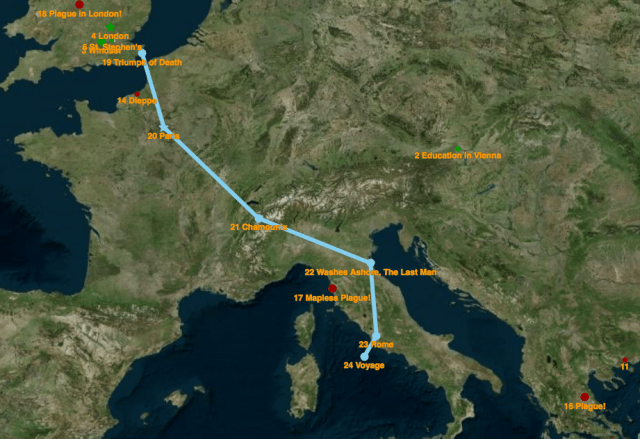
I was alone in the Forum; alone in Rome; alone in the world. Would not one living man —one companion in my weary solitude, be worth all the glory and remembered power of this time–honoured city?
Critics consider The Last Man is Mary Shelley’s most important novel after Frankenstein. I picked this 500+ pages long novel that explores similar thematic concerns as in Frankenstein, though from a vastly different perspective. The nightmarish story envisions the end of humanity from a ruthless and inescapable plague. Full of heart-wrenching loss, The Last Man tests the resilience of humanity, as well as its capacity for sorrow and grief.
The storytelling starts at the constant node following the timeline in a similar manner though sometimes, with deep descriptive instances, somewhere it does feel a dragging and one might feel tempt to rush through it. These instances occur only a few number of times most notably when Shelley often passed over the moments of action or character growth with a short summary, but that certainly never affects her descriptions of places or emotional states. Like many other Victorian authors, Shelley felt no need to rush the plot along, nor to curtail her flood of words. Luckily, she backed them up with ideas and feelings, so it was not merely the empty deluge of words.
The book is very thematically interesting set in the 2090s, and Shelley again with her magical yet plain looking words, tries to expose her internal views. Much of the book is a deconstruction of Romanticism, showing how an aesthete’s optimism never long survives contact with the real world. The reactions to loss and grief are as various as they are in real life: some characters fall into madness, some in to cold and hardheartedness, and others in to deeper conviction to help those still alive.
Since the story involves a large-scale apocalypse, the inspiration behind the novel is, I guess, intensely personal. At the time of its production, Shelley had suffered a series of tragic, insurmountable losses. By 1819, she had lost three children—one at birth and two in early childhood. In 1824, her husband, the major Romantic poet Percy Bysshe Shelley, drowned in a shipwreck at the age of 29 and friend and fellow poet, Lord Byron.
One can also imagine that her two primary characters, Alan and Lord Raymond, are based, on her husband and Lord Byron.
I was for ever with him. There was a sensibility and sweetness in his disposition, that gave a tender and unearthly tone to our converse. Then he was gay as a lark carolling from its skiey tower, soaring in thought as an eagle, innocent as the mild–eyed dove.
As the plot advances, a reader observes that these high-minded, idealistic philosophies dwindle into irrelevance as society falls apart, man by man, until the reader is left with only the narrator, who believes himself to be the last man on earth.
The plague at Athens had been preceded and caused by the contagion from the East; and the scene of havoc and death continued to be acted there, on a scale of fearful magnitude. A hope that the visitation of the present year would prove the last, kept up the spirits of the merchants connected with these countries; but the inhabitants were driven to despair, or to a resignation which, arising from fanaticism, assumed the same dark hue. America had also received the taint; and, were it yellow fever or plague, the epidemic was gifted with a virulence before unfelt. The devastation was not confined to the towns, but spread throughout the country; the hunter died in the woods, the peasant in the corn–fields, and the fisher on his native waters.
Throughout this process, one can admire with ease and then lose character after character. Thus, this ongoing tragedy makes me feel Shelley’s own personal struggles as she mirrors her own grief by examining it through all the various angles and scenarios afforded by the realm of fiction.
With the apocalyptic instance, Shelley recognizes the death of mankind as fall of art, of idealism, of love and joy, and all the heights that we have reached, or hoped to reach.
The air is empoisoned, and each human being inhales death, even while in youth and health, their hopes are in the flower. We called to mind the plague of 1348, when it was calculated that a third of mankind had been destroyed. As yet western Europe was uninfected; would it always be so?
The death of man is a tragedy, but till the death arrives, we can only hope to outlive them with advancements in our lives and replacing previous hopes them with new ones.
A truce to philosophy!—Life is before me, and I rush into possession. Hope, glory, love, and blameless ambition are my guides, and my soul knows no dread. What has been, though sweet, is gone; the present is good only because it is about to change, and the to come is all my own. Do I fear, that my heart palpitates? high aspirations cause the flow of my blood; my eyes seem to penetrate the cloudy midnight of time, and to discern within the depths of its darkness, the fruition of all my soul desires.
Good points: writing is superb, with plenty of flourishes in the style of romanticism. The romances are always pure and there’s an ideal being sought out – the perfect man and the perfect woman. Nature is also seen through the eyes of the romantics – as a force to be reckoned with, having it’s own part to play in the story.
Then mighty art thou, O wind, to be throned above all other vicegerents of nature’s power; whether thou comest destroying from the east, or pregnant with elementary life from the west; thee the clouds obey; the sun is subservient to thee; the shoreless ocean is thy slave! Thou sweepest over the earth, and oaks, the growth of centuries, submit to thy viewless axe; the snow–drift is scattered on the pinnacles of the Alps, the avalanche thunders down their vallies. Thou holdest the keys of the frost, and canst first chain and then set free the streams; under thy gentle governance the buds and leaves are born, they flourish nursed by thee.
Bad points: plague only kicks in half way through the book (page 250). The plague is caused by an orb who caused a partial eclipse. The old English is sometimes tedious to read. Not as bad as Rider Haggard – She but still slow reading.

 One Book a Week (Julia Reads Books)
Leave a comment