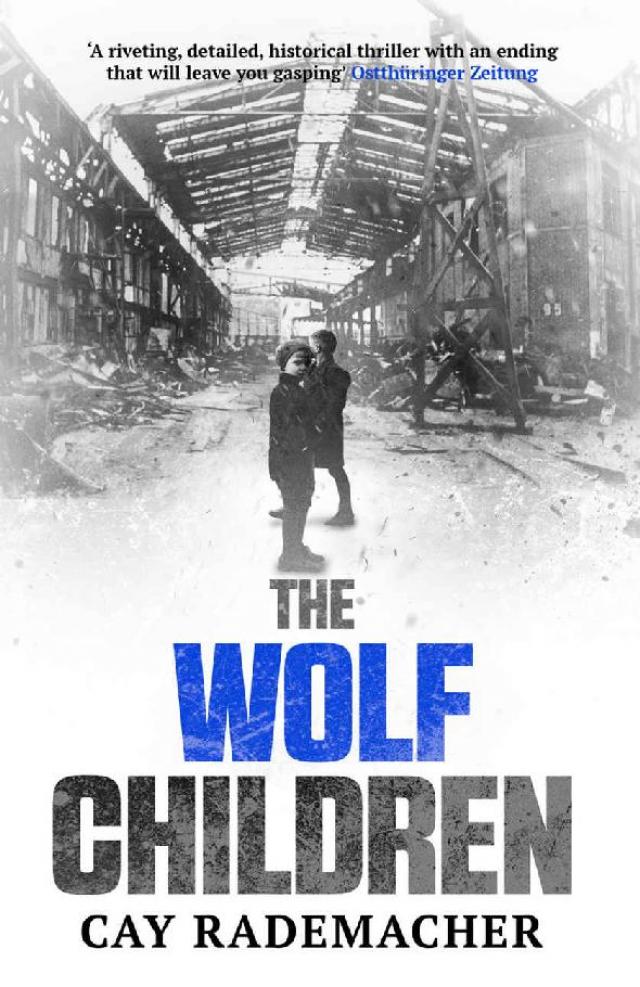
Hamburg 1947: It is the year of extremes.
After a bitterly cold winter of starvation, the bombed city groans under excruciating heat. And Chief Inspector Frank Stave is confronted with a new case.
In the ruins of a shipyard, the corpse of a boy is found and Stave’s hunt for the killer leads him into the world of wolf children- orphaned children who have fled from the Occupied Eastern Territories and now united in gangs.
When two more bodies are discovered Stave is under even increasing pressure as he struggles to keep his personal life together too…
The dead boy’s blood coated the five-hundred-pound British bomb like a red veil. Light coming through the shattered roof of the warehouse fell on the corpse and on the unexploded bomb, a thing the size of a man, like some monstrous fish that had buried itself in the concrete flooring. The rest of the warehouse was in darkness. It was as if the sunlight shining in on the boy and the bomb was some giant theatrical floodlight, Chief Inspector Frank Stave of Hamburg CID thought to himself.
Chief Inspector Frank Stave has to hunt for a child killer which leads him into the world of the wolf children. Wolf children were among the 40,000 orphaned children who lived feral, in gangs and on the city streets having fled from the Occupied Eastern Territories.

Wolf children was what people called the boys and girls from the east. Orphans who had lost their parents in the fighting in Silesia and East Prussia or afterwards on the flight westwards. Fathers shot, mothers raped to death, houses burnt down. Children who survived in the woods and on the moors, like wild animals, begging, stealing, eating whatever they could get hold of. Many of them didn’t even know their own names. They would make a home in burnt-out barns or the ruins of houses, and somehow or other managed to reach the western occupation zones. There were supposed to be a few hundred of them living in the ruins of Hamburg.
There’s three elements to these books: Frank Stave’s own story (his dead wife, his son missing in action, and his new love interest); the depiction of Hamburg in the immediate post-War period under occupation by the British army; and of course the murder case.
Once again it’s the depiction of Hamburg which works best – there’s lots of atmosphere and compelling detail about day to day life.
Frank Stave’s story is interesting despite his somewhat bizarre personality and inability to be straightforward, and this novel leaves many threads still hanging and awaiting some kind of resolution in the final book.
About the author
CAY RADEMACHER was born in 1965 and studied Anglo-American history, ancient history, and philosophy in Cologne and Washington. He has been an editor at Geo since 1999, and was instrumental in setting up renowned history magazine Geo-Epoche. The Wolf Children is the second novel in the Inspector Stave series, following The Murderer in Ruins (Arcadia Books, 2015). He now lives in France with his wife and children, where his new crime series is set.
PETER MILLAR is an award-winning British journalist, author and translator, and has been a correspondent for Reuters, The Sunday Times and Sunday Telegraph. He has written a number of books, including All Gone to Look for America and 1989: The Berlin Wall, My Part in Its Downfall. He has also translated from German, Corinne Hofmann’s best-selling White Masai series of memoirs, Martin Suter’s A Deal with the Devil and Cay Rademacher’s The Murderer in Ruins.
 One Book a Week (Julia Reads Books)
Leave a comment