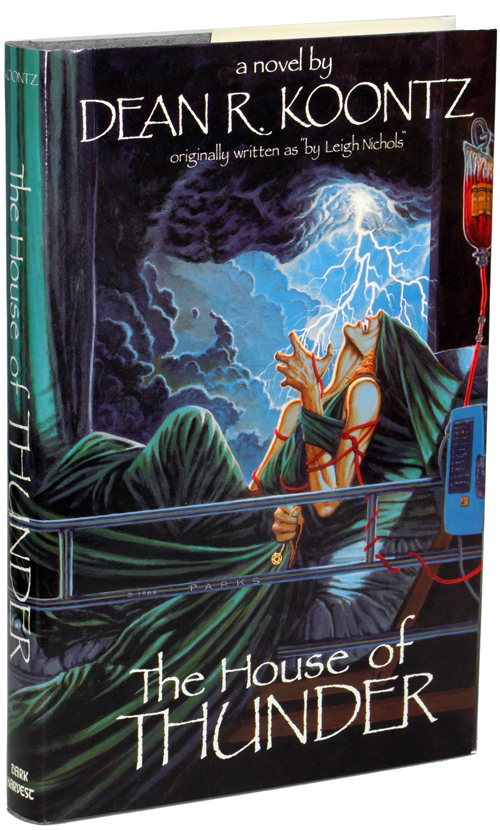
Slowly and painfully recovering in a hospital room from the terrible accident that has left her with amnesia, a woman begins to solve the mysteries of her past, beginning with one stormy night of violence waged by four young men in a place called “House of Thunder”.
“Thunder?” McGee asked. “Why?”“A subterranean stream enters the cave high in one corner and tumbles down a series of ledges. The sound of the falling water echoes off the limestone, so there’s a continuous rumbling in the place.”
What a thrill ride this book has been! Susan suffers an accident that leaves her with a head injury. Upon waking in the hospital after being in a coma for a while, she finds herself mistrusting the doctors, the nurses and even her own senses. It felt like I was reading Pines (Wayward Pines #1) by Blake Crouch.
What makes it even weirder, the woman starts seeing people around her that look like exact copies (down to the Boston accent) of people she’s put behind bars for the murder of her Uni boyfriend. Even when presented with evidence that the people she’d seen are patients or gainfully employed by the hospital, she can’t shake the feeling that they are the same people. But how is that possible since 15 years or so have passed since she’d last seen them and they don’t seem to have aged a bit.
So where does that leave me? she wondered. With two look-alikes? The old doppelgänger theory again? If they are just a couple of doubles for Harch and Quince, were they cast up here by chance? Or is there a purpose to their arrival in this place, at this particular time? What sort of purpose? Is someone out to get me? And isn’t that a crazy thought, for God’s sake!
Her physician is helping her in the recovery and is also trying to battle her malnutrition from the coma period and her amnesia. It also helps that he is charismatic, sexy and undoubtedly more interested in Susan than a doctor should be.
Dr. McGee made his evening rounds shortly before dinnertime. He was wearing blue slacks, a red plaid shirt, a blue vee-neck sweater, and an open lab coat. Chest hairs, as black as those on his head, curled out of the open neck of his shirt. He was so slim and handsome that he looked as if he had stepped out of a men’s fashion advertisement in a slick magazine

Things start getting even creepier when all four of the attackers are now present around her in the hospital, including two she knows for sure died in a car crash years ago. Ghosts? Ghouls? Mental breakdowns?.
Impossible. Nightmare creatures. They were meant to inhabit only the land of sleep. But she was awake. And they were here. Real.
And I know what’s going through your mind right now, she thought. You’re thinking about my head injury, about the coma, about the possibility of minor brain damage that didn’t show up on any of your X rays or other tests, a tiny embolism, or perhaps an exceedingly small hemorrhage in a threadlike cerebral capillary. You’re wondering if I’ve received a brain injury that just, by sheerest chance, happens to affect that infinitesimal lump of gray tissue in which the memories of the House of Thunder are stored; you’re wondering if such an injury—a sand-grain blood clot or a minuscule, ruptured vessel—could cause those memories to become excessively vivid, resulting in my preoccupation with that one event in my life. Am I fixated on Jerry’s murder for the simple reason that some abnormal pressure in my brain is focusing my attention relentlessly upon the House of Thunder? Is that pressure causing me to fantasize new developments in that old nightmare? Is that nearly microscopic rotten spot in my head altering my perceptions so that I believe I see dead ringers for Harch and the others, when, in reality, neither Bill Richmond nor Peter Johnson nor the two orderlies bear any resemblance whatsoever to the quartet of fraternity brothers? Well, maybe that is what’s happening to me. But then again, maybe not. One minute, I think that is the explanation. The next minute, I know it must be something else altogether. They’re not dead ringers. They are dead ringers. They’re not the real Harch, Quince, Jellicoe, and Parker. They are the real Harch, Quince, Jellicoe, and Parker. I just don’t know. God help me, I just don’t know what’s happening to me, so dear Dr. McGee, I can’t blame you for your confusion and your doubts.
She said, “I’m fully aware that my problem is most likely either psychological or the result of some organically rooted brain dysfunction related to the auto accident, or possibly not to the accident directly but to the effects of spending three weeks in a coma.”
Clear evidence of an unnatural fixation, obsession, psychological illness or brain dysfunction, she thought. I say I don’t believe in elaborate fantasies. I say I don’t believe in the occult. And yet I believe these four are real, including the two who are dead. It makes no sense.
Henceforth, she wasn’t going to take any of the medications that she was given. For all she knew, these people were slowly poisoning her.
Because she was a scientist, it naturally occurred to her that she might be the subject of an experiment. She might even have willingly agreed to take part in it. An experiment having to do with sensory manipulation or with mind control.There was sufficient precedent to inspire such a theory. In the 1960s and 1970s, some scientists had voluntarily subjected themselves to sensory deprivation experiments, settling into dark, warm, watery SD tanks for such extended lengths of time that they temporarily lost all touch with reality and began to hallucinate.Susan was sure she wasn’t hallucinating, but she wondered if the second floor of the hospital had been adapted for an experiment in mind control or brainwashing techniques. Brainwashing sounded like a good bet. Was that the kind of research the Milestone Corporation was engaged in?

Milestone (according to McGee) had one primary goal: to develop an ultimate weapon—a particle beam, some new kind of laser, a new biological weapon, anything— which would in one way or another render nuclear weaponry not just obsolete but useless. The U.S. government had for some time been convinced that the Soviet Union was seeking nuclear superiority with the express intention of launching a first-strike attack the moment that such a monstrous tactic was likely to result in a clean, painless Soviet victory. But it hadn’t been possible, until recently, to sell the American public on the idea that rearmament was a desperate necessity. Therefore, in the middle Seventies, the President and the Secretary of Defense could see no hope except a miracle; a miracle weapon that would cancel out the Soviet arsenal and free mankind from the specter of an atomic holocaust. While it wasn’t possible to launch a massive arms buildup costing hundreds of billions of dollars, it was possible to secretly establish a new research facility, better funded than any had ever been before, and hope that American ingenuity would pull the country’s ass out of the fire. In a sense, Milestone became America’s last best hope.
 One Book a Week (Julia Reads Books)
Leave a comment