I’ve seen The Martian movie but haven’t managed to read the book (yet) so when I saw there was another from the same author, I thought I’d give it a go and see if I like the writing style or not.
The book is awesome when it comes to science of the Moon, how life on Moon would be like, colonies development and life on a planet with a gravity 6 times less than what we’re used to.
Blurb
WELCOME TO ARTEMIS. The first city on the moon.
Population 2,000. Mostly tourists.
Some criminals.
Jazz Bashara is one of the criminals. She lives in a poor area of Artemis and subsidises her work as a porter with smuggling contraband onto the moon. But it’s not enough.
So when she’s offered the chance to make a lot of money she jumps at it. But though planning a crime in 1/6th gravity may be more fun, it’s also a lot more dangerous.
When you live on the moon, of course you have a dark side…
“By the way, we also hate it when people . . . call Artemis “the city in space.” We’re not in space; we’re on the moon. I’m mean, technically, we’re in space, but so is London.”
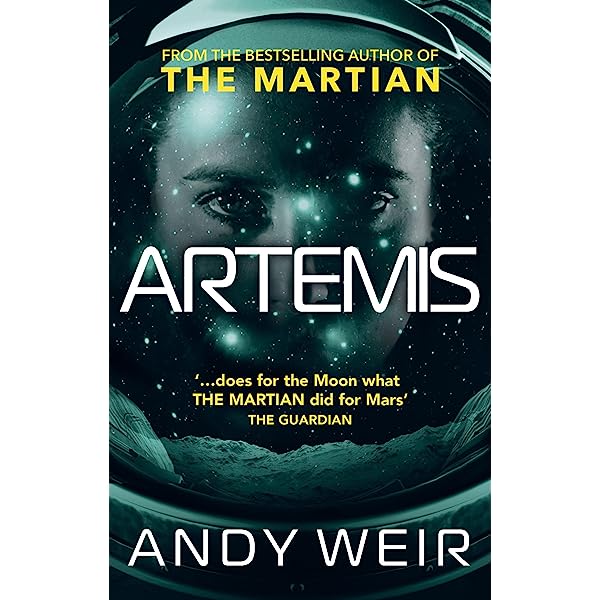
The story takes place on the Moon inside a space colony and details how life and the people are like – what type of food they eat, what is contraband and what isn’t and how everything drills down to how much money you have (called slugs) and who you know (so not that different from regular Earth).
“Armstrong Bubble sits in the middle, surrounded by Aldrin, Conrad, Bean, and Shepard.”
Named after great men of space exploration, the colony is a mix of unsavoury characters and Earth-vacationers and rich life-time residents who enjoy the lax rules.
“If you commit a serious crime, Artemis deports you to the victim’s country. Let their nation exact revenge on you for it.”
The main character Jazz, a 26 years old woman, was talking and thinking like a cringy 15 years old boy. She mentions a few times her appearance and sexuality unnaturally. I don’t understand why men authors struggle so hard to write female characters.
Also, the author chooses to have a Muslim (non-practising) narrator, which could lead to important representation, but it’s hard not to cringe when he addresses his narrative to a solely white, non-Muslim audience:
“Okay, you can stop pretending you know what a niqab is. It’s a traditional Islamic headwear that covers the lower face.”
And then goes on to show Jazz using said niqab as a disguise while carrying out criminal activity. She pleasantly declares:
“Great way to wear a mask without arousing suspicion.”
Yikes.
“I live in Conrad Down 15, a grungy area fifteen floors underground in Conrad Bubble. If my neighborhood were wine, connoisseurs would describe it as “shitty, with overtones of failure and poor life decisions.”
The science fiction aspect of the book is absolutely entertaining and the speculative part of it is so close to what may be that it’s impossible to dismiss it as just an author thinking the impossible.
“I’ve always been a fan of science fiction. I grew up watching Star Trek. Now I get to live it!”
“Star Trek?” Trond asked. “Seriously? That’s like a hundred years old.”
“Quality is quality,” Jin said. “Age is irrelevant. No one bitches about Shakespeare fans.”
The book has its good parts – like some of the dialogue and the science bits.
The bad parts of the book are quite a few though – starting from over-explaning how welding works, jumping from one plot to another and never quite explaining why the entire colony is run by Kenyans.
The main story is also broken up with Jazz’s letters to a Kenyan pen pal, starting when she is nine years old, but this never really goes anywhere and feels kind of pointless. The gay jokes are also peppered through the software. Just because Weir wrote a gay character into the book doesn’t mean he gets to demean that character. The only person who’s probably mentioned as having more sex than Jazz is Dale. Because gay men are sluts, am I right? Get it? Because they have a lot of sex. Oh, and not only is the gay guy a slut, but he stole Jazz’s boyfriend and slept with him while he and Jazz were still together. If I had my way I would ban Weir from ever writing about another gay character in any book for the rest of his life.
It’s like Andy Weir wrote everything that came to his mind, without even processing the information. Maybe if he’d done that, he would have realized that some of the things he wrote were truly, astonishingly offensive.
Some are going to say that he’s ‘‘keeping it real’’. You know, ‘‘telling it like it is’’, but all he’s doing is perpetrating stereotypes and racist ways of thinking, like him implying that a niqab is a mask that raises suspicion.* It’s just so wrong for him to say that.
I think all in all, I was pretty let down by the book. I want to read The Martian though before I abandon all hope of reading anything of Andy Weir’s again.
2023 Update
Guess who accidentally bought the book once more after finding it on sale in a book store having forgotten completely that I have read and reviewed this book. And only about one third in, there was something about Jazz who stirred my memory. The uber-feminism, the do-it-all-attitude, the resilience in the face of adversity.
And to be fair, it might have been the science part of factories on the moon producing aluminium from moon-rock having a by-product of Oxygen that we so much need to survive that hinted to me that I might have already read this book. And possibly didn’t like it very much.
I sat down to think whether it was the same lack of sensibility and possibly the over-the-top heroine that made her so unlikeable. What exactly about this book is so off-putting? I think Andy Weir cannot write from a female point of view.
My rating stands;
 One Book a Week (Julia Reads Books)
Leave a comment